Why the Turkish Coast
Just across the narrow channel that separates the Dodecanese from the Turkish mainland lies one of the most spectacular and historically layered coastlines in the entire Mediterranean. The southwestern coast of Turkey — known to sailors as the Turquoise Coast, and with good reason — stretches for hundreds of kilometres in a succession of deeply sheltered bays, pine-forested headlands, ancient ruins, and clear, luminous water of a colour so vivid it seems almost improbable. From the Aegean to the Mediterranean, from the glamorous marinas of Bodrum to the remote, untouched coves of the Datça Peninsula to the great natural harbour of Marmaris, this is a coastline that rewards every kind of traveller and every kind of sailing, and it begins, from the Dodecanese, with a crossing that can be as short as a single morning.
The relationship between these shores and the Greek islands opposite is ancient and intimate. For millennia, the same sailors, merchants, and adventurers moved freely between what are now two different countries, trading and building and worshipping across a sea that no border has ever truly divided. The ruins of ancient Greek cities — Halicarnassus, Knidos, ancient Amos — line the Turkish coast directly opposite the islands that were always their nearest neighbours. Arriving on the Turkish coast from the Dodecanese, you are not crossing into a different world. You are extending the same world, deeper and further, into territory of equal beauty and equal historical richness.
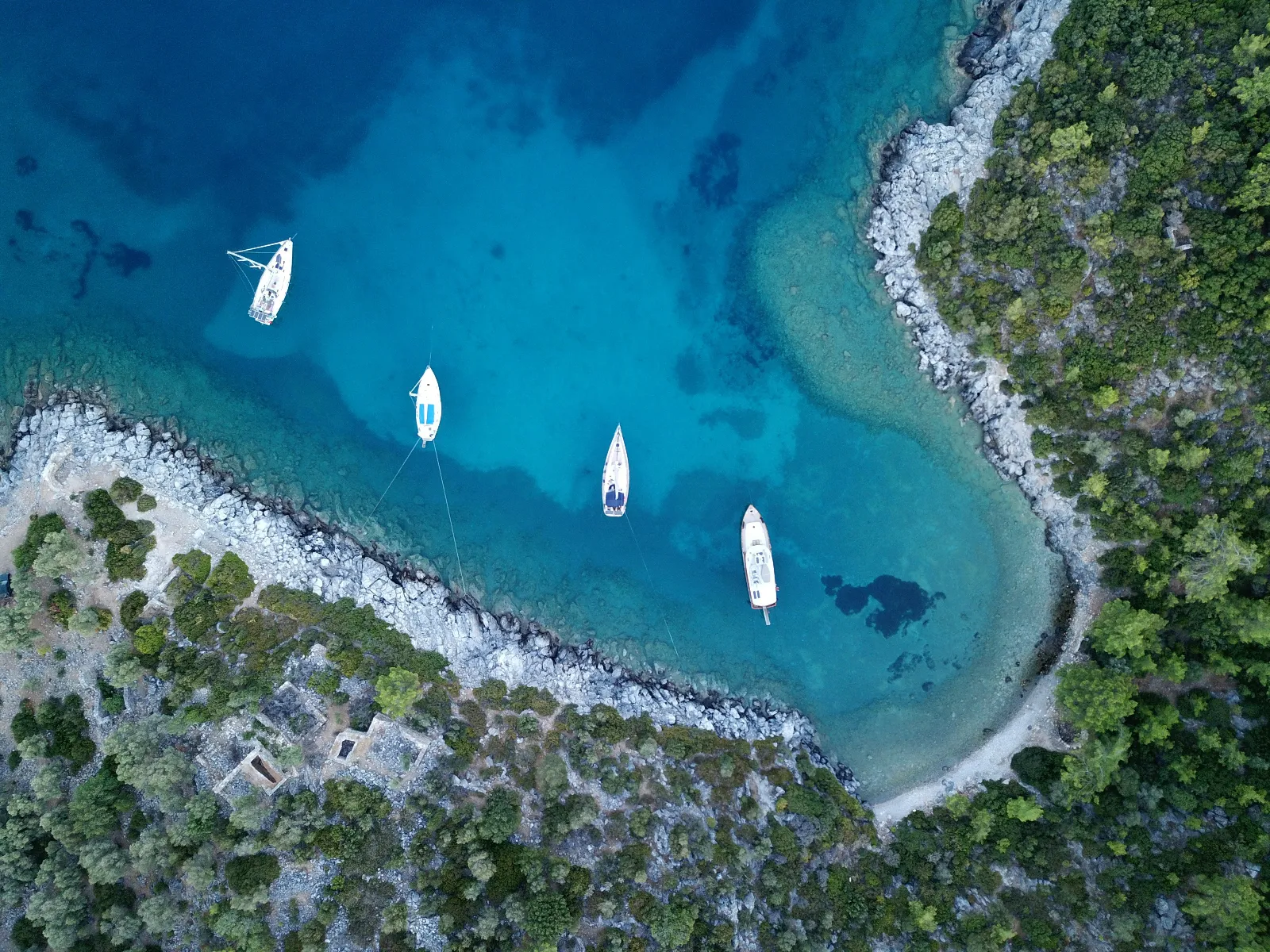
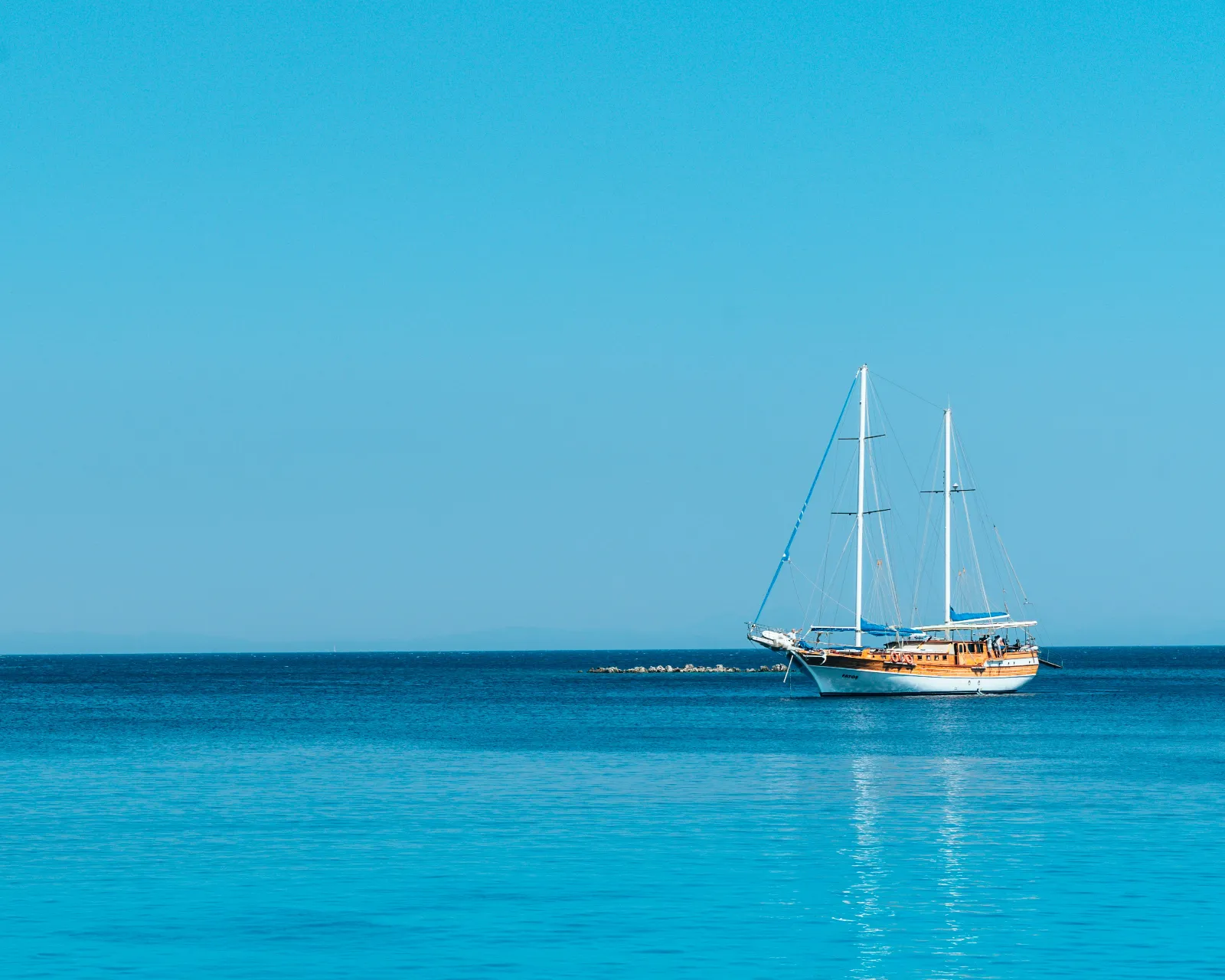
Sailing these waters, the transitions are seamless and the rewards are continuous. A morning departure from Rhodes or Symi can have you anchored off a Turkish beach by early afternoon, swimming in water every bit as clear and blue as anything in the Greek islands, with the pine-covered mountains of Anatolia rising behind you and the silhouettes of the Dodecanese still visible on the western horizon. This is one of the great short crossings of the Mediterranean, and what awaits on the other side is extraordinary.
Bodrum — The St. Tropez of the Aegean
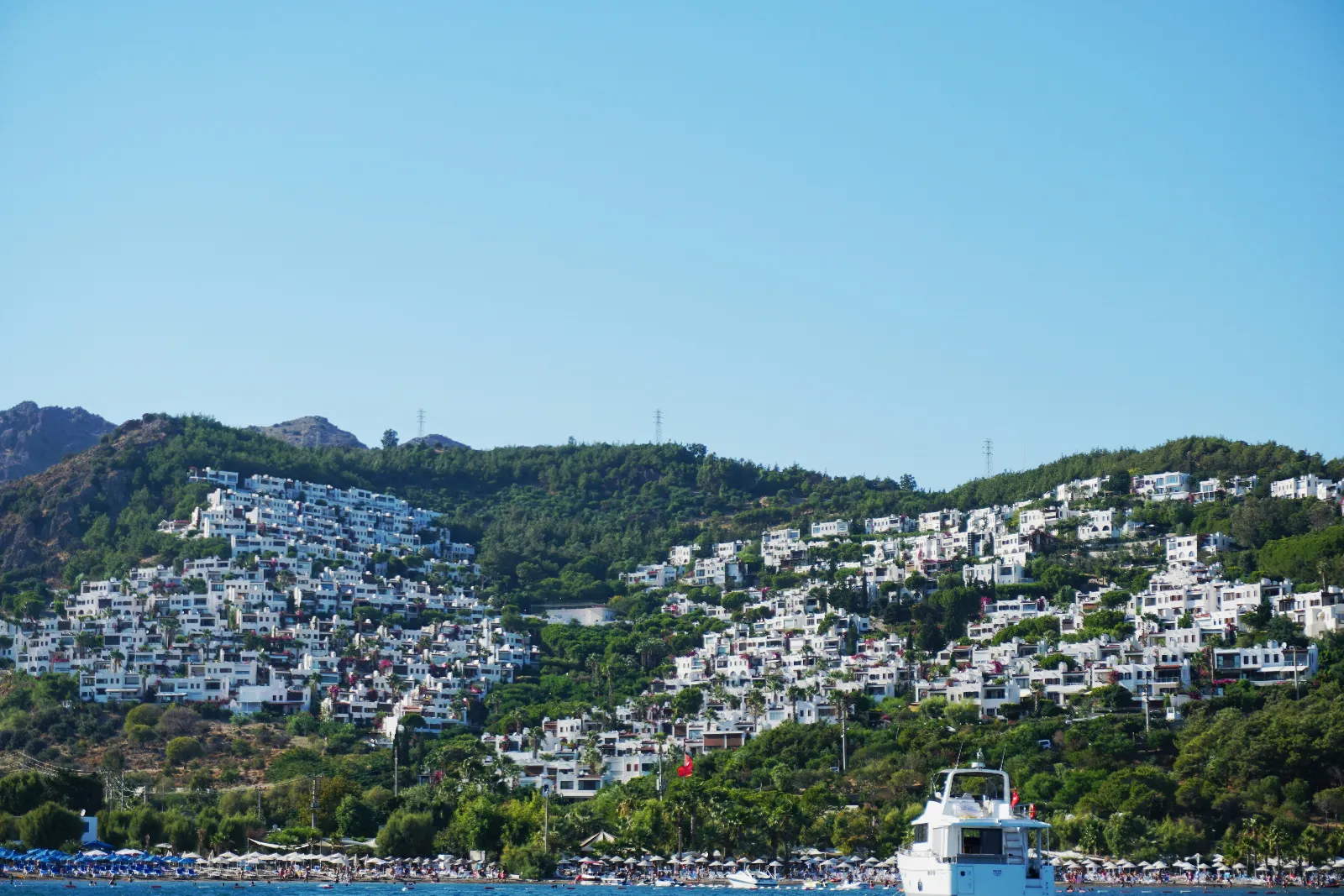
Sailing into Bodrum harbour on a clear Aegean morning — the great medieval castle rising from the water directly ahead, the white cubic houses of the town climbing the hillside behind it, the twin bays of the peninsula framing everything in a sweep of brilliant blue — you understand immediately why this peninsula has been drawing sailors, traders, philosophers, and pleasure-seekers to its shores for three thousand years. Bodrum is not simply a resort that has grown up around a beautiful coastline. It is a place with a genuine identity — complex, layered, proud, and possessed of a cultural vitality that sets it apart from every other destination on the Turkish Aegean.
The city that stands here today is built on the ruins of ancient Halicarnassus, one of the great cities of the classical world and the birthplace of Herodotus — the father of history — born here around 484 BC. The Mausoleum of Halicarnassus, built for King Mausolus in the 4th century BC, was one of the Seven Wonders of the Ancient World and gave its name to an entire category of funerary architecture. The Castle of St. Peter, built by the Knights of St. John from those same ancient stones in the early 15th century, is one of the finest Crusader fortifications in the eastern Mediterranean, and the Bodrum Museum of Underwater Archaeology housed within it is simply the best museum of its kind in the world — home to treasures recovered from ancient shipwrecks, including the Bronze Age Uluburun wreck dating to the 14th century BC, which carried artefacts from eleven different ancient cultures.
And yet Bodrum is also, without apology, one of the most fashionable and energetic resort towns on the entire Turkish coast. Its marina is one of the most prestigious in the Mediterranean, its beach clubs are among the most celebrated, and its coastline is fringed with over sixty Blue Flag beaches of extraordinary variety — from the calm, family-friendly sands of Bitez and the clear, reef-rich waters of Akyarlar directly facing Kos, to the elegant exclusivity of Türkbükü on the northern coast and the ancient submerged ruins of Gümüşlük at the western tip, where the remains of the ancient harbour walls of Myndos lie clearly visible beneath the shallow water. This combination — ancient wonder and modern pleasure, history and hedonism, philosophy and fashion — is what gives Bodrum its particular and intoxicating character, and it is a combination found nowhere else in quite the same proportions.
Datça Peninsula — Where Two Seas Meet
If Bodrum is the Aegean coast at its most cosmopolitan and celebrated, the Datça Peninsula — stretching some 75 kilometres westward from Marmaris like a long, thin finger pointing toward the Greek islands — is the coast at its most wild, most remote, and most purely itself. This is one of the least developed and most scenically magnificent stretches of coastline in all of Turkey, a narrow ridge of mountains and valleys dropping steeply to the sea on both sides, with the Aegean to the north and the Mediterranean to the south, their waters meeting at the very tip of the peninsula in conditions of extraordinary natural drama. The Dodecanese islands of Symi, Tilos, and Rhodes are visible from its southern shore, and the sense of being at a crossing point between two worlds — Greek and Turkish, Aegean and Mediterranean, ancient and living — is constant and deeply pleasurable.
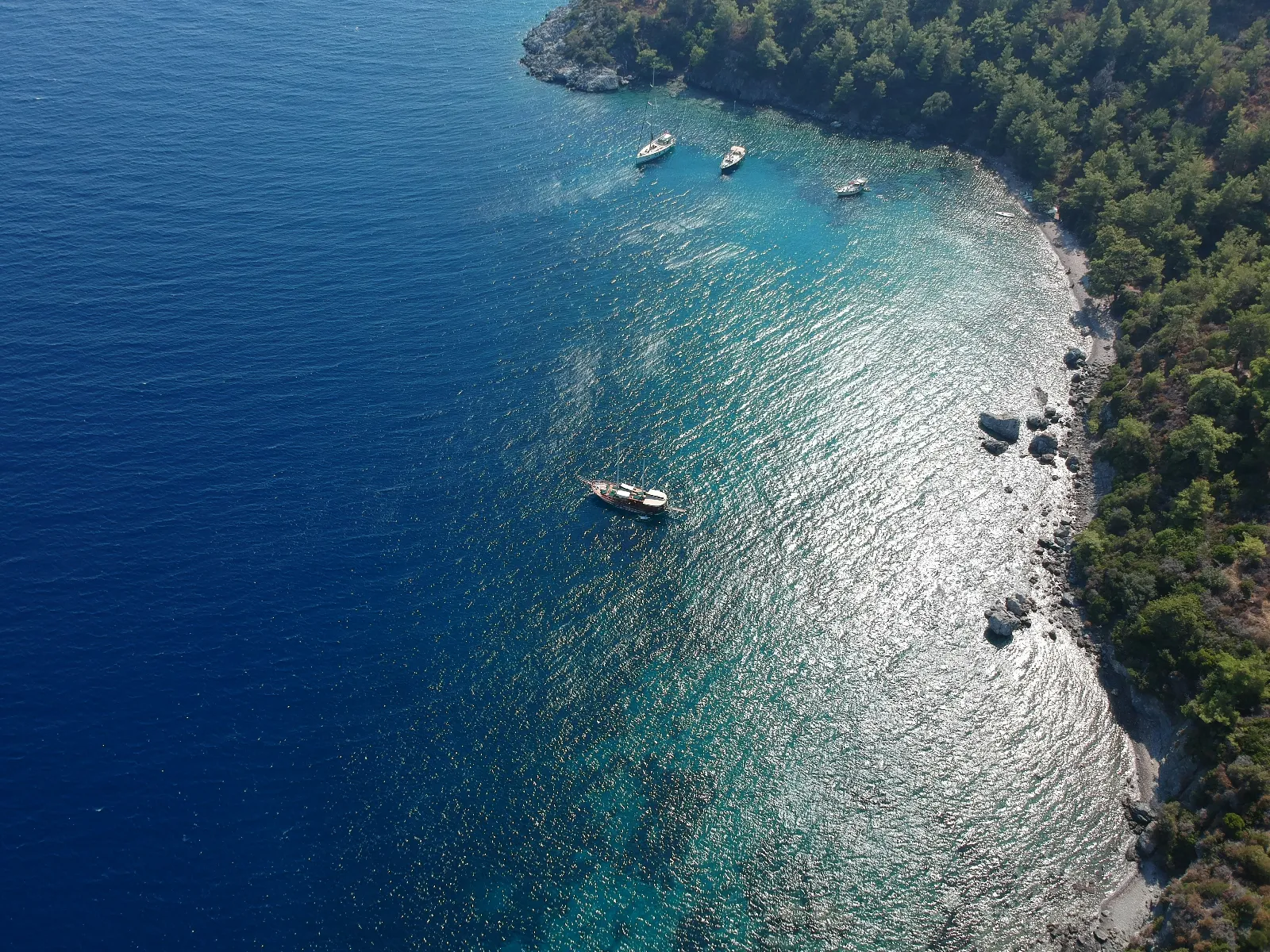
The peninsula is geologically and botanically remarkable. Its unique microclimate has produced local varieties of almond, olive, and pomegranate cultivated here for millennia, along with some of Turkey’s finest honey and olive oil. Its 52 bays and coves, most of them accessible only by sea, are among the most pristine and least visited swimming spots on the entire Turkish coast — among them the perfectly sheltered pebble cove of Hayıtbükü on the northern shore, the wide golden sweep of Palamutbükü on the Mediterranean side, and the sequence of secret inlets between them that reveal themselves, one by one, to the sailor willing to take the time.
At the very tip of the peninsula, where the two seas collide in wind and current, lie the ruins of ancient Knidos — one of the great cities of classical antiquity, home to the physician Ctesias and the mathematician Eudoxus, and famous across the ancient world for the statue of Aphrodite by Praxiteles, considered the most beautiful sculpture of antiquity. The ruins spread across a hillside above two natural harbours — one facing the Aegean, one the Mediterranean — and arriving by yacht directly into the ancient harbour, with the temple ruins visible on the slopes above and two seas glittering in opposite directions, is one of the most evocative and thrilling approaches on the entire Turkish coast. Between Knidos and the charming, genuinely traditional town of Datça — with its cobbled old quarter of Eski Datça, its excellent local restaurants, and its celebrated almond blossom festival each February — the Datça Peninsula offers an itinerary of extraordinary quality for those who choose to sail it slowly and attentively.
Marmaris — Gateway to the Turquoise Coast
Marmaris announces itself to the arriving sailor in a manner that is simply among the most spectacular on the entire Turkish coast. As your yacht navigates the narrow entrance channel — wooded hills rising steeply on both sides, the water deep and dark green beneath the pine trees — and the great bay of Marmaris suddenly opens before you in its full, extraordinary extent, you understand why this natural harbour has been considered one of the finest in the Mediterranean since antiquity. Suleiman the Magnificent assembled his fleet here before the siege of Rhodes in 1522 and reportedly declared it the most beautiful harbour he had ever seen. The instinct was sound. Marmaris has been built for arrival.
The town is Turkey’s most significant yacht charter base, and the infrastructure that surrounds its enormous marina — chandleries, provisioning, charter agencies, repair yards — is of a quality and comprehensiveness that makes Marmaris the natural hub of any extended cruise along the Turkish coast. But behind the marina and the busy waterfront promenade, the old town of Marmaris climbs the hillside below a 16th-century Ottoman castle in a tangle of narrow cobblestone lanes of genuine charm, and the surrounding coastline — stretching east toward the pine-forested bays of İçmeler and Turunç, west toward the remote inlets of the Bozburun Peninsula, and north to the legendary Sedir Island with its extraordinary Cleopatra Beach — is some of the most beautiful on the entire Turquoise Coast.
Marmaris is also the gateway to a wider world. To the west, the Datça Peninsula beckons in a sequence of increasingly wild and pristine bays. To the east, the Bozburun Peninsula offers superb cruising through sheltered inlets and traditional wooden boat-building villages. Further east still, the Turquoise Coast unfolds toward Fethiye, Göcek, and the ancient Lycian shore — a sequence of natural wonders and archaeological treasures that can absorb weeks of sailing without repeating itself. Marmaris is not just a destination. It is a threshold — and what lies beyond it in every direction is extraordinary.
Why Choose the Turkish Coast
The Turkish coast opposite the Dodecanese is, in the most complete sense, the natural extension of a Greek island sailing itinerary — not an alternative to the islands, but a complement to them, adding a dimension of scale, landscape, and historical depth that no single island group can provide on its own. The crossing from Rhodes to Bodrum, from Symi to Datça, from Tilos to Marmaris, is one of the great short passages of the Mediterranean: brief enough to be easy, long enough to feel like a genuine journey, and rewarding on arrival in ways that fully justify the decision to make it.
Together, Bodrum, Datça, and Marmaris offer three completely distinct experiences within a single, compact cruising ground. Bodrum delivers cosmopolitan energy, exceptional historical heritage, and beaches of the very highest quality. Datça offers wilderness, authenticity, ancient ruins at the edge of the world, and a quality of solitude that is increasingly rare in the Mediterranean. Marmaris provides the full infrastructure of a major yachting centre in a setting of spectacular natural beauty, with access to some of the finest day-sailing routes on the Turkish coast in every direction. Sailed together in sequence — Bodrum to Datça to Marmaris, or in the reverse — they form one of the most varied and rewarding coastal itineraries available to a yacht anywhere in the eastern Mediterranean.
What the Turkish coast shares with the Greek islands that face it across the water is the quality that defines the entire Aegean: a combination of light, history, and natural beauty that is found together in this intensity nowhere else on earth. The water is the same water. The light is the same light. The ancient stones belong to the same civilisation. Only the language changes as you cross the channel, and even that, in the harbour towns that have been welcoming sailors from both shores for three thousand years, is a distinction that the sea has always made feel rather less important than it might appear on a map.