Why Delos
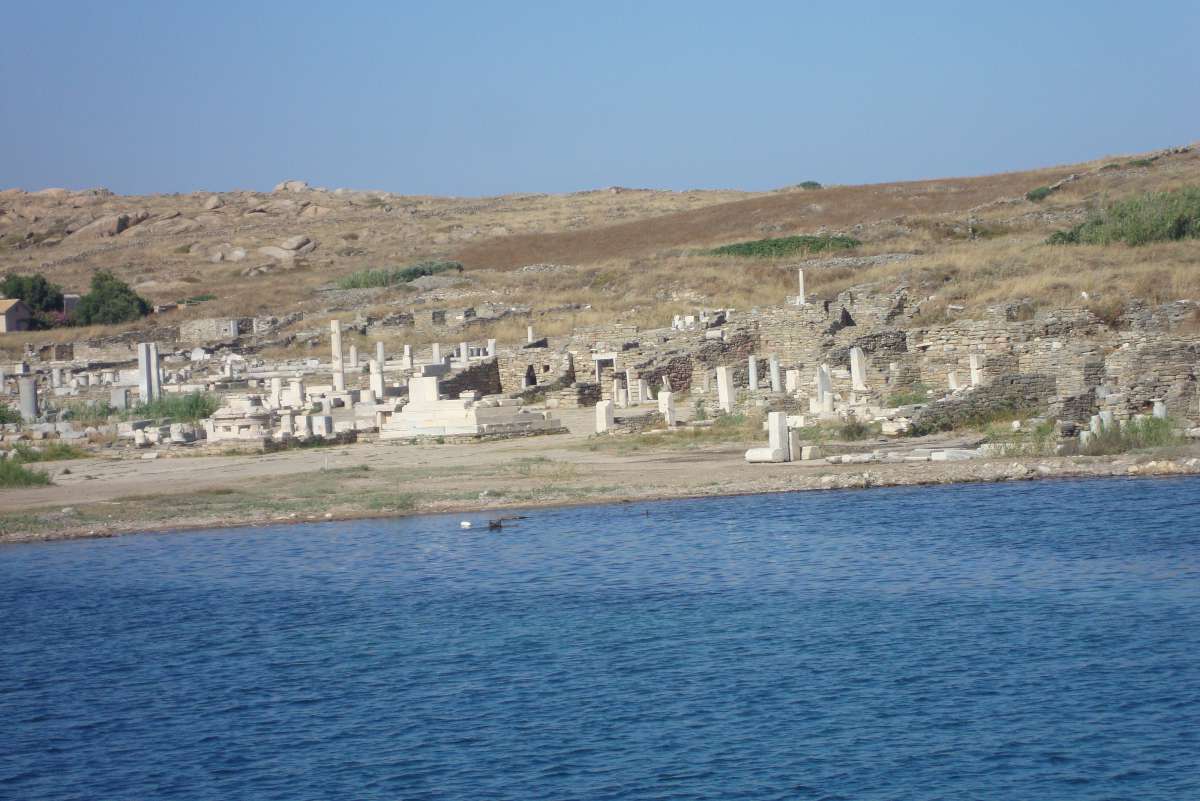
There are places in the world where the weight of human history is so great and so concentrated that the act of setting foot on them feels categorically different from ordinary travel — where the ground beneath you carries a significance so ancient and so profound that the experience of being there operates simultaneously on the level of the intellectual, the emotional, and something deeper and less easily named that has to do with the direct, unmediated encounter with the very origins of the civilisation that shaped the world you live in. Delos is one of these places. A tiny, uninhabited island of barely 3.4 square kilometres in the heart of the Cyclades, lying between Mykonos and Rhenea in the geographic centre of the archipelago, Delos is the most sacred island in the ancient Greek world — the mythological birthplace of Apollo and Artemis, the religious centre of the Aegean for over a millennium, the seat of the Delian League that shaped the destiny of classical Greece, and at the height of its commercial power in the 2nd and 1st centuries BC one of the most important trading centres in the entire Mediterranean world. Its entire surface is a UNESCO World Heritage Site — not a part of it, not selected monuments within it, but the whole island, from shore to shore — and this designation, accurate and appropriate as it is, barely begins to communicate what Delos actually is: the single most important concentration of ancient Greek sacred, civic, and domestic architecture surviving anywhere in the world, preserved in its entirety on an uninhabited island in the middle of the Aegean sea.
The mythology of Delos is as extraordinary as its archaeology. According to Greek tradition, Leto — pregnant with the divine twins Apollo and Artemis by Zeus — wandered the world in search of a place to give birth, rejected by every land that feared the wrath of Hera. Delos alone agreed to receive her — a floating, rootless island that had nothing to lose — and in exchange for its willingness, Apollo caused it to be fixed to the seabed with four diamond columns, transforming it from a wandering rock into the sacred, permanent centre of the Cycladic world. The power of this myth — of the sacred place chosen precisely because it had the courage that others lacked, and rewarded with permanence and centrality for that courage — permeated the ancient Greek imagination for centuries and made Delos the object of religious devotion, political calculation, and artistic patronage from city-states across the entire Greek world. Temples were built here by Athens and by Naxos, by the Delians themselves and by the kings of the Hellenistic dynasties that succeeded Alexander. Votive offerings of extraordinary richness accumulated over centuries. Festivals drawing visitors from across the Aegean were celebrated here with games and music and theatrical performances that were, in the ancient world, second only to the Olympics in their prestige and their cultural significance.
No one is born on Delos today, and no one dies there. The island receives its visitors each morning by boat from Mykonos, gives them the hours of the open site to walk among its extraordinary ruins, and sends them back before evening. It has been uninhabited since the early Byzantine period, and that long emptiness — centuries of silence broken only by the wind and the sea — has preserved the integrity of its ruins in a state that no inhabited site could replicate. Walking Delos in the early morning, before the day’s visitors have fully arrived and while the light is still horizontal and golden across the marble columns and mosaic floors of its ancient houses, is to experience the ancient world at its most immediate, its most physically present, and its most completely overwhelming. It is one of the great experiences of the entire Aegean.
What to Do and What to See
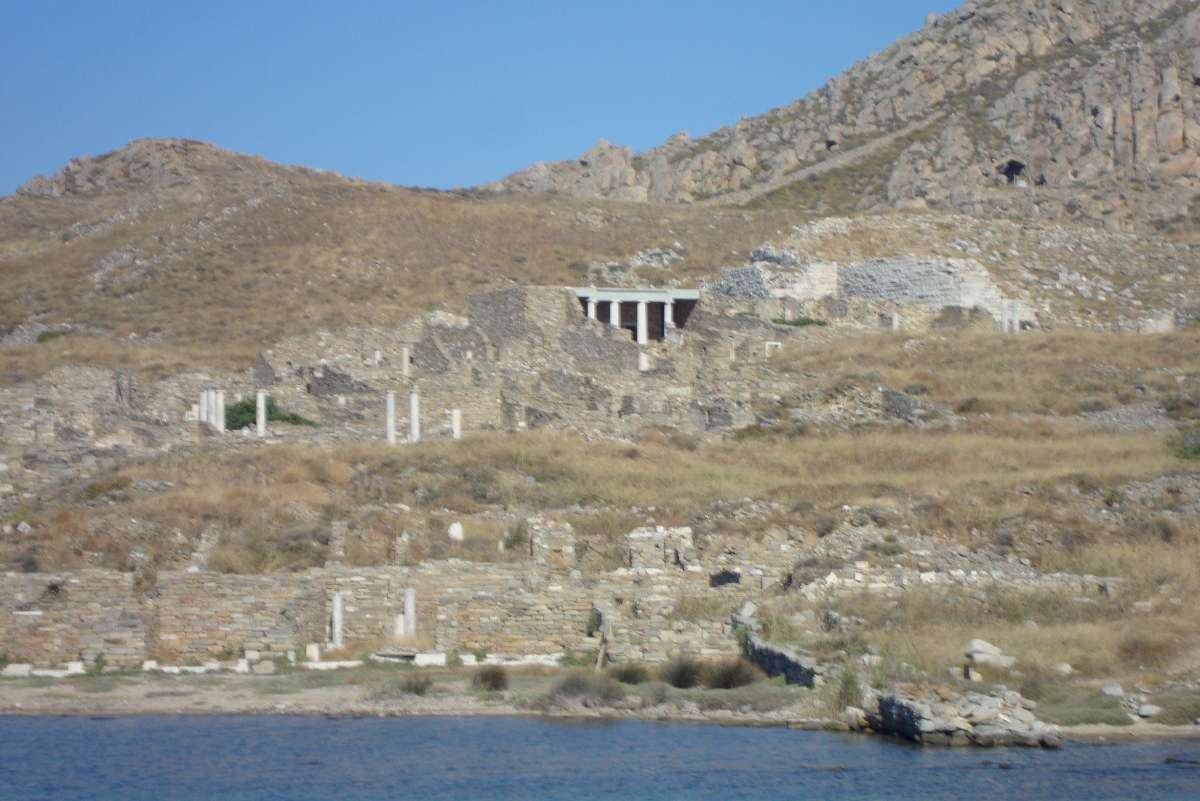
Delos is, in its entirety, a single vast archaeological experience — an island whose every square metre contains some layer of ancient human activity, from the Bronze Age settlements on the summit of Mount Kynthos to the magnificent Hellenistic merchant houses of the lower town with their intact mosaic floors. The site divides naturally into four main areas, each of which repays unhurried exploration and each of which contains monuments of first-rank international importance.
The Sanctuary of Apollo
At the heart of Delos, the great Sanctuary of Apollo — the sacred precinct that was the religious and political centre of the ancient Aegean world for nearly a millennium — contains the remains of three temples to Apollo of different periods and different architectural orders, the foundations of the colossal statue of Apollo dedicated by the Naxians in the 7th century BC, the remains of the Propylaeon gateway, the treasuries dedicated by various Greek cities, and the extraordinary Stoa of the Naxians whose column bases still stand in their original positions. The scale of the sanctuary — its accumulated temples, altars, treasuries, and monuments covering an area that speaks of centuries of continuous religious investment and political competition — is deeply impressive, and the quality of the individual architectural remains, even in their ruined state, gives a vivid and powerful sense of what the sanctuary must have looked like at the height of its magnificence: a forest of marble columns and gold-roofed temples rising from the flat centre of the island against the blue Aegean sky, the most beautiful and the most sacred place in the Greek world.
The Terrace of the Lions
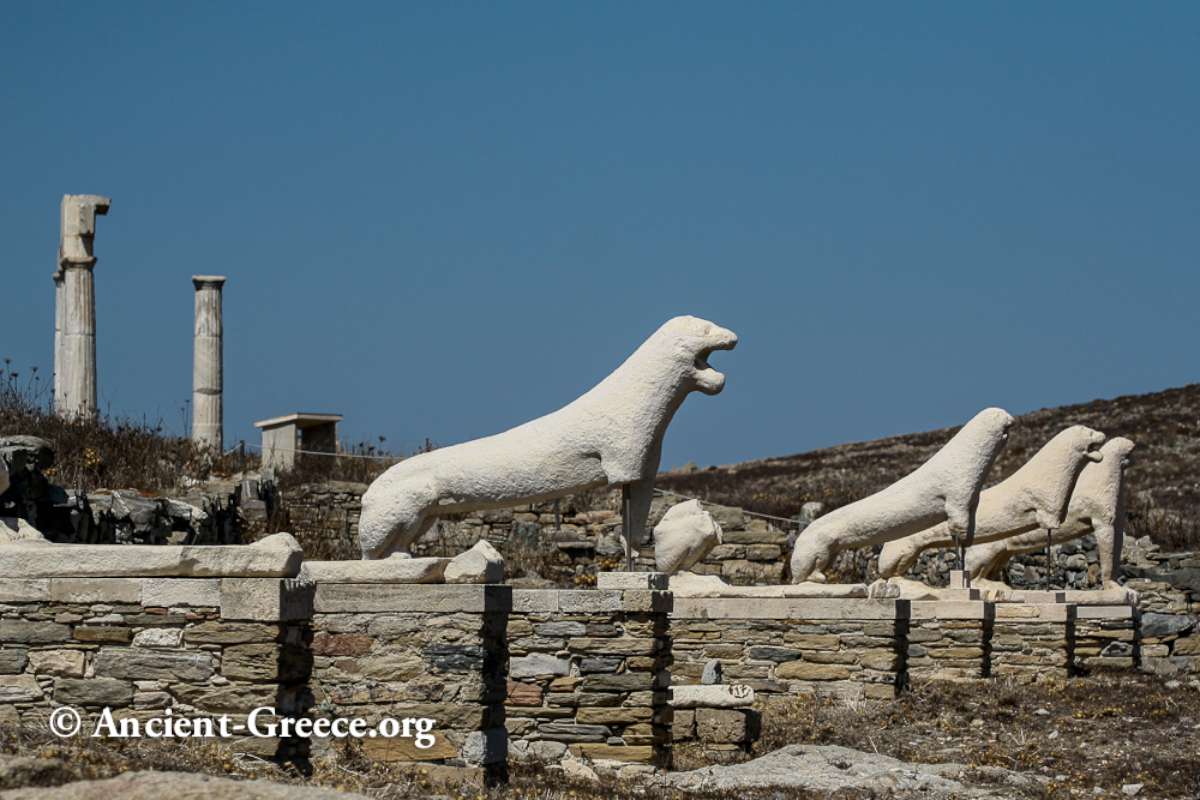
North of the sanctuary, the famous Terrace of the Lions is the single most iconic image of Delos and one of the most powerful and most memorable ancient sculptural ensembles surviving anywhere in the Greek world. Originally a row of at least nine — and possibly as many as sixteen — marble lions dedicated to Apollo by the Naxians in the late 7th century BC, the terrace now preserves five of the original lions in situ, their archaic forms lean and alert and slightly unnerving, their heads turned toward the Sacred Lake they were set to guard with an expression of feline vigilance that five and a half centuries of weathering have made more, not less, intense. The lions are among the earliest examples of monumental Greek sculpture in existence, and their quality — the confident, stylised power of the archaic sculptural tradition at its finest — is extraordinary. Standing before them in the early morning, with the flat, glittering expanse of the Sacred Lake bed behind them and the silence of the uninhabited island around you, is one of the most completely moving experiences that a visit to a Greek archaeological site can provide.
The Theatre and the Theatre Quarter
On the southern slope of the island, the ancient theatre of Delos — carved into the hillside in the Hellenistic period and capable of seating approximately 5,500 spectators — is one of the finest small ancient theatres in the Cyclades, its cavea still substantially intact and its views across the rooftops of the ancient town and out to the surrounding sea of extraordinary beauty. Below the theatre, the Theatre Quarter preserves the most complete surviving example of ancient Greek domestic architecture anywhere in the world — a dense network of Hellenistic and Roman-period merchant houses of considerable size and considerable sophistication, their peristyle courtyards, reception rooms, and private cisterns still clearly legible, and their floor mosaics — the famous mosaic of Dionysus riding a panther in the House of Dionysus, the dolphin mosaic of the House of the Dolphins, the mask mosaic of the House of the Masks — among the finest surviving examples of ancient mosaic art in the entire Mediterranean. These mosaics, created for the private houses of wealthy merchants in the 2nd century BC, are of a quality and a refinement that consistently and justifiably astonishes visitors encountering them for the first time.
Mount Kynthos and the Summit Sanctuaries
Rising to 113 metres at the southern end of the island, Mount Kynthos is the highest point on Delos and the site of the island’s oldest human habitation — circular huts dating from the 3rd millennium BC have been excavated near the summit, placing the first human presence on Delos firmly in the Early Bronze Age. The summit itself was sacred in antiquity and was occupied by a series of small sanctuaries — to Zeus and Athena, to the Syrian gods Hadad and Atargatis, to the Egyptian gods Isis and Serapis — whose remains speak eloquently of the extraordinary cosmopolitan religious diversity of Delos at the height of its commercial power, when merchants from across the Mediterranean world brought their own gods with them and were permitted to worship them freely on the sacred island. The climb to the summit of Kynthos, following the ancient sacred way through the sanctuary of the Syrian gods and past the cave sanctuary of Kynthos, takes about 30 minutes from the harbour and rewards the effort with a panoramic view of the entire island below — the full extent of the ancient city laid out in perfect clarity, the surrounding Cyclades visible on every horizon, and the channel between Delos and Mykonos glittering in the morning light.
The Archaeological Museum of Delos
Adjacent to the sanctuary, the island’s Archaeological Museum houses finds from the excavations conducted by the French School of Athens since 1873 — the longest continuous excavation programme at any single site in Greece — in a collection of exceptional quality and exceptional scope. The marble sculptures — including fragments of the colossal Naxian Apollo, architectural decorations from the island’s temples, and a series of portrait heads of the Roman period of remarkable quality — are displayed in a setting of great clarity and great coherence. The collection of bronzes, terracottas, jewellery, and everyday objects from the ancient houses of the commercial quarter provides a vivid and intimate portrait of daily life on the island at the height of its prosperity in the 2nd century BC — when its population of some 30,000 people made it one of the most densely inhabited islands in the ancient Mediterranean.
The Ancient Synagogue
Among the most surprising and most historically significant of Delos’s many monuments is the ancient synagogue on the eastern shore of the island — one of the oldest known synagogues in the world, dating to between 150 and 128 BC, its existence on Delos a testament to the extraordinary religious diversity of the island at the height of its commercial activity. The presence of a Jewish community on Delos in the 2nd century BC, large and prosperous enough to build and maintain a dedicated synagogue of this quality, speaks volumes about the cosmopolitan, commercially driven, religiously tolerant character of the island in the Hellenistic period — a character that made it, briefly and brilliantly, one of the great meeting points of the ancient world.
Why Choose Delos
Delos is the destination for every traveller who comes to the Greek islands with any feeling for the ancient world — for the mythology and the art and the architectural ambition and the sheer human intelligence and human devotion that produced, on this small, flat, wind-swept island in the centre of the Cyclades, one of the greatest concentrations of sacred and civic building in the history of western civilisation. It is for those for whom the famous mosaic of Dionysus and the archaic lions and the view from the summit of Kynthos over the ruins of the ancient city are not merely beautiful things to see but genuine encounters with the deep past — with the people and the beliefs and the ambitions that made the Greek world what it was and, through it, made the western world what it is.
For those sailing the central Cyclades, Delos is the single most important cultural destination in the entire archipelago — a site of international significance available as a day excursion from any anchorage between Mykonos and Paros, its morning boat connections from Mykonos making it accessible with the minimum of planning and the maximum of reward. The experience of arriving at Delos by small boat in the early morning — the ancient harbour wall visible from the sea, the columns of the sanctuary rising above the low island profile as you approach, the silence of the uninhabited island broken only by the sea birds and the wind — is one of the finest approaches to an ancient site available anywhere in the Mediterranean, and it is, for the sailor who has spent the previous night at anchor in the Cyclades, a morning of such concentrated historical and natural beauty that it justifies an entire voyage.
What Delos ultimately gives the visitor who comes to it with open eyes and genuine attention is the rarest and most valuable thing that travel in Greece can provide — the feeling of direct, unmediated contact with the civilisation that invented the idea of the sacred island, that built temples of marble to the gods of light and music and reason on this bare and wind-swept rock in the middle of the sea, and that left behind, in their ruins and their mosaics and their archaic sculptures, a record of human aspiration and human devotion of such completeness and such beauty that it has been drawing travellers to this small island in the Cyclades for two and a half thousand years and shows, in the quality of the wonder it still produces in those who come, absolutely no signs of stopping.