Why Nisyros
There are moments in travel that stop you completely — that override every expectation and demand that you simply stand still and take in what is before you. On Nisyros, that moment arrives when you first look down into the caldera. Standing at the rim of a volcanic crater on a small Aegean island, staring into a vast bowl of sulphurous earth — grey, ochre, and pale yellow, steaming quietly in the sun — with the deep blue of the Mediterranean visible beyond the crater walls, you understand immediately that Nisyros is unlike any other island in Greece. There is simply nothing else like it in the entire Aegean, and that geological singularity gives this small, round, intensely volcanic island a character and an atmosphere that are wholly and startlingly its own.
Nisyros sits in the southeastern Dodecanese, south of Kos and north of Rhodes, a near-perfect circle of land roughly eight kilometres in diameter that is, in geological terms, a dormant stratovolcano rising from the sea floor. The island is still very much alive beneath its surface — minor eruptions and ground tremors occur periodically, the last significant eruption having taken place in 1888 — and the volcanic energy that created it permeates everything above ground as well: in the jet-black lava beaches of the coast, in the thermal springs that bubble up at the water’s edge, in the extraordinary mineral richness of the soil that makes the island’s gardens and terraces extravagantly fertile. Pomegranates, figs, almonds, capers, and the island’s celebrated souma liqueur all grow here with a vigour that speaks of soil supercharged by millennia of volcanic activity.
But Nisyros is not merely a geological curiosity wearing the clothes of a Greek island. It is a place of genuine beauty and deeply authentic character — one of the few Aegean islands that tourism has touched lightly enough that its traditional life continues undisturbed. The white and ochre village of Mandraki, the island’s capital, climbs its hillside above a small harbour in a cascade of flower-filled lanes and neoclassical facades. The clifftop village of Nikia, perched on the caldera rim, is one of the most perfectly preserved traditional villages in the entire Dodecanese. And the warmth with which the island’s small permanent population receives visitors who make the journey here — arriving by yacht rather than day-trip ferry, staying long enough to see the evening light on the caldera walls — is the warmth of a community that is genuinely pleased to share what it has.
What to Do and What to See
Nisyros is compact enough to explore thoroughly in a few days, and varied enough to reward every one of them. The volcanic landscape of the interior, the traditional villages perched on the caldera rim, the black-sand beaches of the coast, and the extraordinary thermal activity at the water’s edge combine to create an itinerary unlike anything else available in the Dodecanese. Approaching by yacht, you arrive into a harbour that day-trip tourists leave by afternoon — meaning that those who stay experience the island at its most authentic, most peaceful, and most beautiful.
The Caldera and Stefanos Crater
The volcanic caldera of Nisyros is the island’s defining feature and one of the most extraordinary natural sights in all of Greece. Roughly three kilometres in diameter, the caldera was formed by the collapse of the volcanic cone and is now a surreal landscape of steaming fumaroles, bubbling mud pools, and vast expanses of pale, mineral-streaked earth that smells sharply of sulphur and feels nothing whatsoever like the rest of the Aegean. Within the caldera, the Stefanos crater is the largest and most accessible — a depression some 330 metres in diameter and 30 metres deep, its floor a pale moonscape of crystallised sulphur deposits, active gas vents, and patches of ground warm to the touch. Walking across the floor of Stefanos, with the crater walls rising around you and the steam rising from the vents at your feet, is one of the genuinely unique experiences available to a traveller in Greece.
Mandraki Village
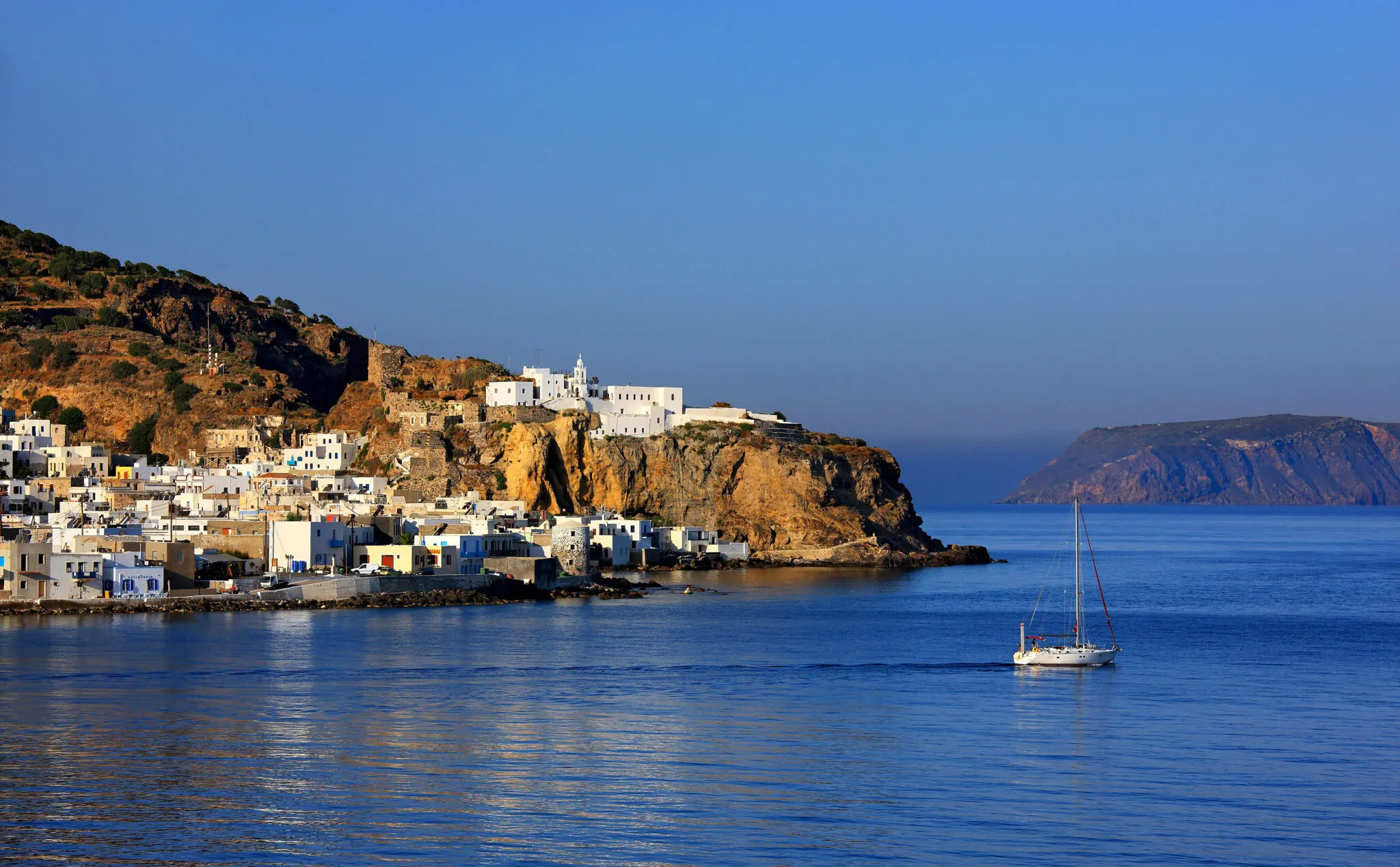
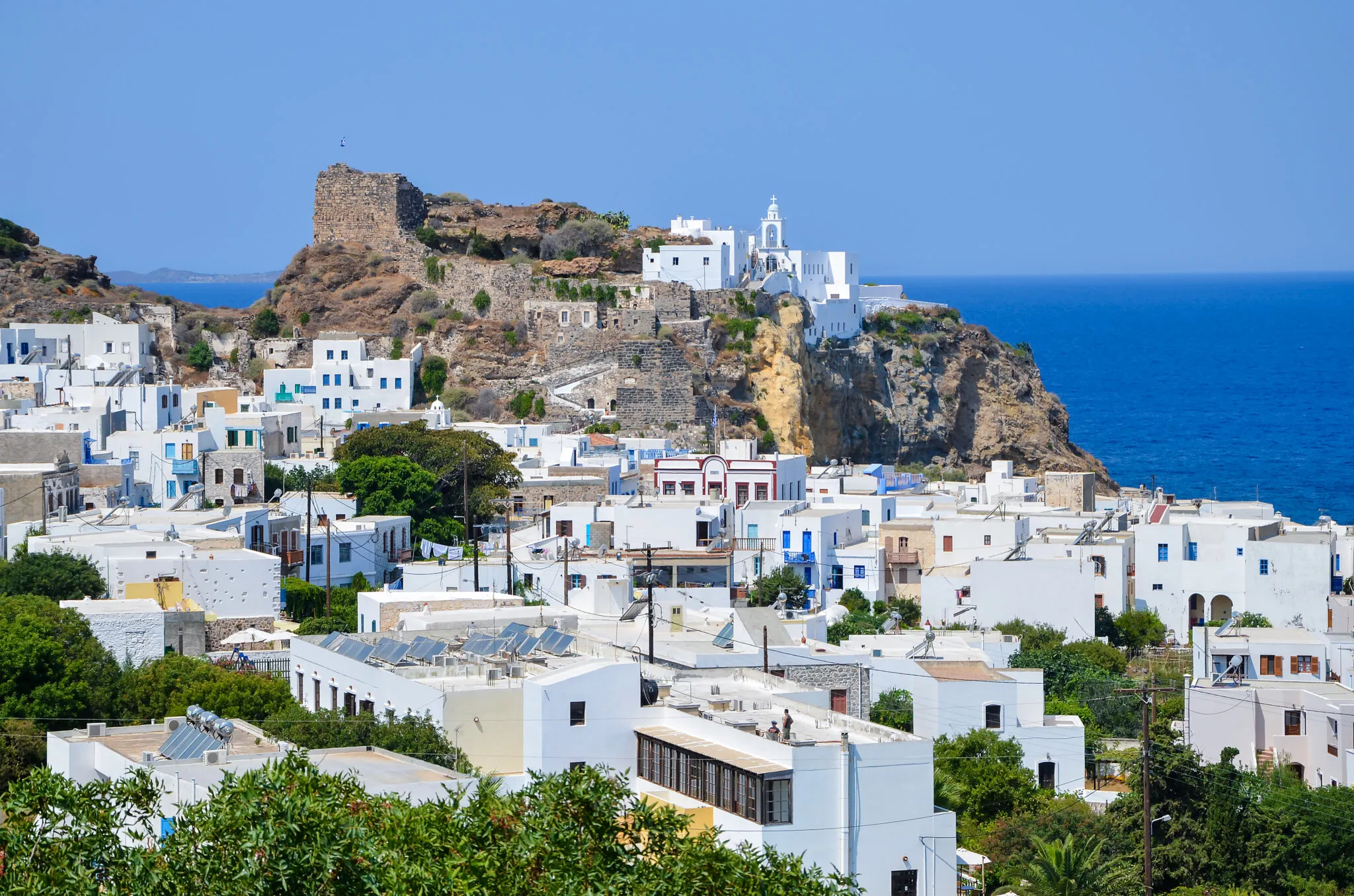
The island’s capital and main harbour settlement, Mandraki is a village of considerable charm built along a narrow coastal shelf beneath a dramatic clifftop crowned by a medieval castle. Its streets are narrow, whitewashed, and draped in bougainvillea, and the neoclassical houses that line them — many with beautifully decorated facades of painted plaster and carved stone — give the village an architectural elegance that belies its tiny size. The main square is the social heart of the island, shaded by a great mulberry tree, surrounded by the oldest kafeneions and tavernas, and utterly unhurried in a way that makes it the ideal place to sit with a coffee and a plate of the island’s extraordinary capers and simply watch the Nisyrian day unfold. The waterfront is simple and unpretentious — a short quay, a few fishing boats, the sea — and all the more beautiful for it.
The Kastro of Mandraki
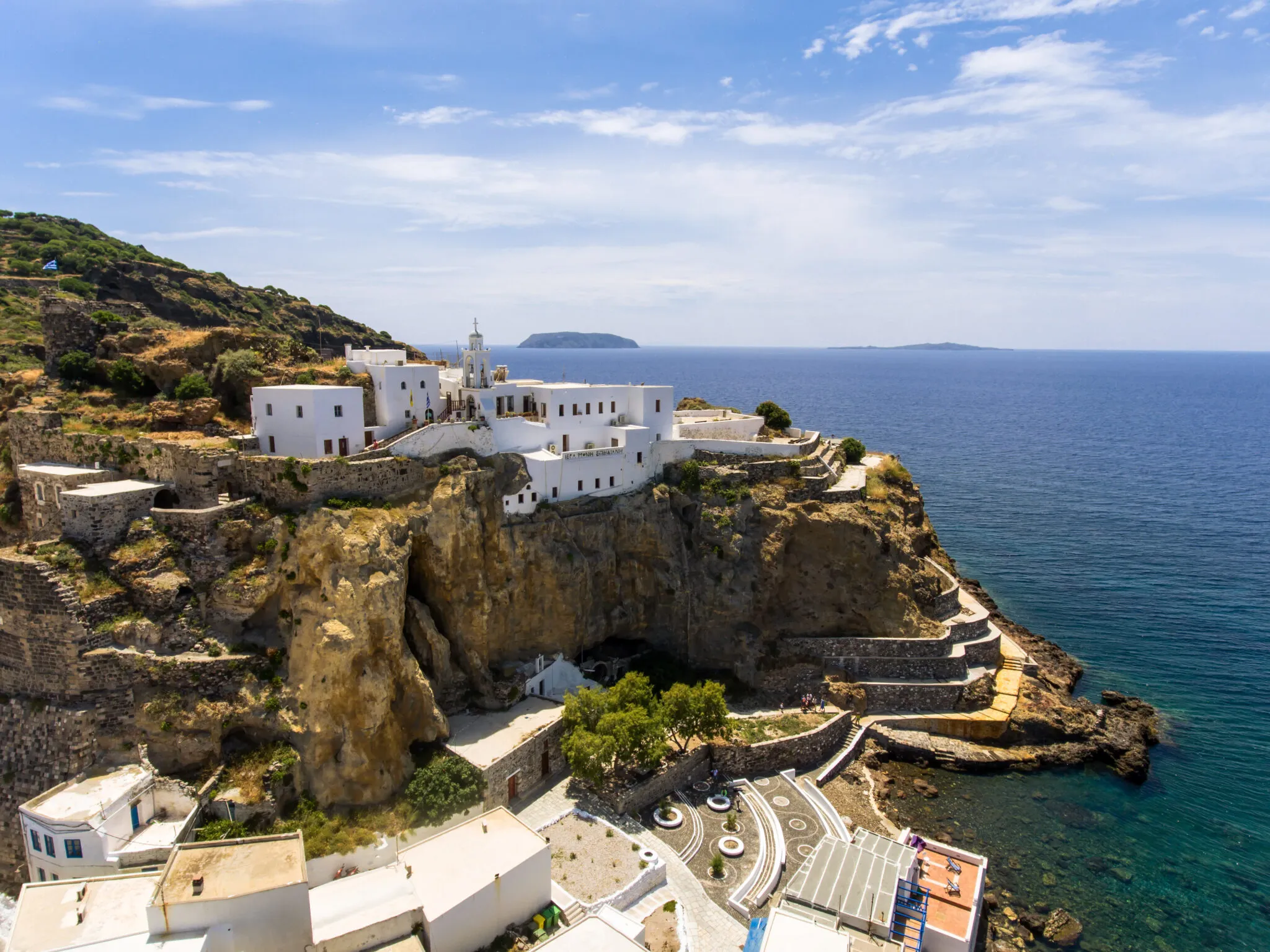
Above the village, the medieval castle that crowns the clifftop is one of the most dramatically sited fortifications in the Dodecanese. Built originally in the early medieval period and strengthened subsequently by the Knights of St. John, the Kastro of Mandraki is unusual in that it is not a conventional castle but rather an entire fortified quarter — a neighbourhood of houses built within and against the castle walls, with the outer walls of the houses serving simultaneously as the defensive perimeter of the settlement. Inside the castle enclosure, the small monastery of Panagia Spiliani — Our Lady of the Cave — is carved directly into the volcanic rock and houses a revered Byzantine icon of the Virgin, making it one of the most sacred sites on the island. The views from the castle ramparts over the harbour, the sea, and the distant mountains of Kos are magnificent.
Nikia Village
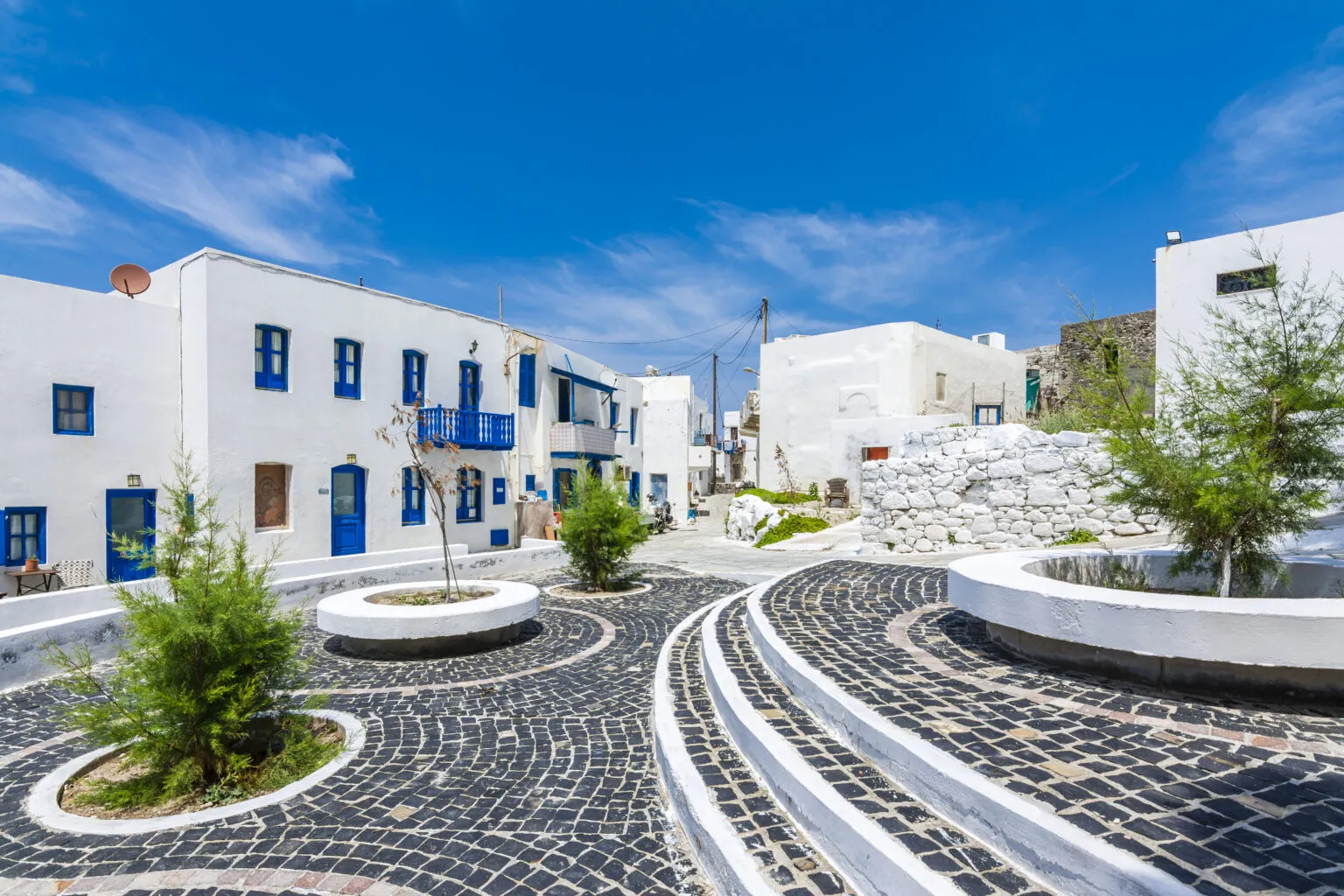
Perched on the southeastern rim of the caldera at an altitude of some 400 metres, the village of Nikia is a place that stops travellers in their tracks. It is small — fewer than a hundred permanent residents — but it is one of the most perfectly and lovingly maintained traditional villages in the entire Dodecanese. Its circular main square, paved in black and white volcanic stone in a traditional mosaic pattern, is ringed by immaculate whitewashed houses with bright blue shutters and overflowing flower pots. Every lane, every doorstep, every façade is kept with a pride and care that speaks of a community that genuinely loves where it lives. From the viewpoint at the village’s edge, the caldera drops away below you in a vast, steaming sweep, and beyond it the sea glitters in every direction. It is one of the finest views in the Dodecanese.
Paloi and the Thermal Springs
On the northeastern coast, the small fishing village of Paloi is the most relaxed and traditional settlement on the island’s shoreline — a cluster of tavernas and simple houses around a tiny harbour, with a black-pebble beach and water of remarkable clarity. Just east of Paloi, the thermal springs of Loutra emerge at the sea’s edge, where hot mineral water filters up through the volcanic rock and mixes with the cooler Aegean. The old Ottoman-era bathhouse nearby is one of the island’s most evocative structures, now partially restored and used for therapeutic bathing in waters whose temperature hovers around 37 degrees. Arriving at Paloi by yacht in the late afternoon, swimming in the warm waters near the springs, and then eating fresh fish at one of the harbour tavernas as the sun sets over Kos is a sequence of pleasures that is hard to improve upon.
The Black Beaches
The volcanic geology of Nisyros has produced a coastline quite unlike the sandy or pebble shores of its neighbours. Much of the island’s coast is composed of striking black and dark grey volcanic rock and pebble, and the beaches that exist here — particularly at Lies on the northwestern coast and Pachia Ammos on the eastern side — have a dramatic, otherworldly quality that is completely distinctive. The contrast of jet-black stone against the brilliant turquoise of the Aegean is visually extraordinary, and the water clarity around these volcanic shores is exceptional — perfect for snorkelling and diving over underwater lava formations. Accessible most easily by yacht, these beaches are among the most memorable and unusual swimming spots in the Dodecanese.
The Ancient Walls of Palaiokastro
Near the village of Nikia, the ancient fortification known as Palaiokastro preserves some of the finest examples of Hellenistic polygonal masonry surviving anywhere in Greece. The walls, built from enormous interlocking blocks of volcanic lava stone fitted together without mortar in a technique of extraordinary precision, date to around the 4th century BC and are still standing to a considerable height. The site is little-visited and barely signposted, which only adds to the sense of genuine discovery when you find it — massive, ancient, and quietly magnificent in its remote hillside setting above the caldera.
Pachia Ammos Beach
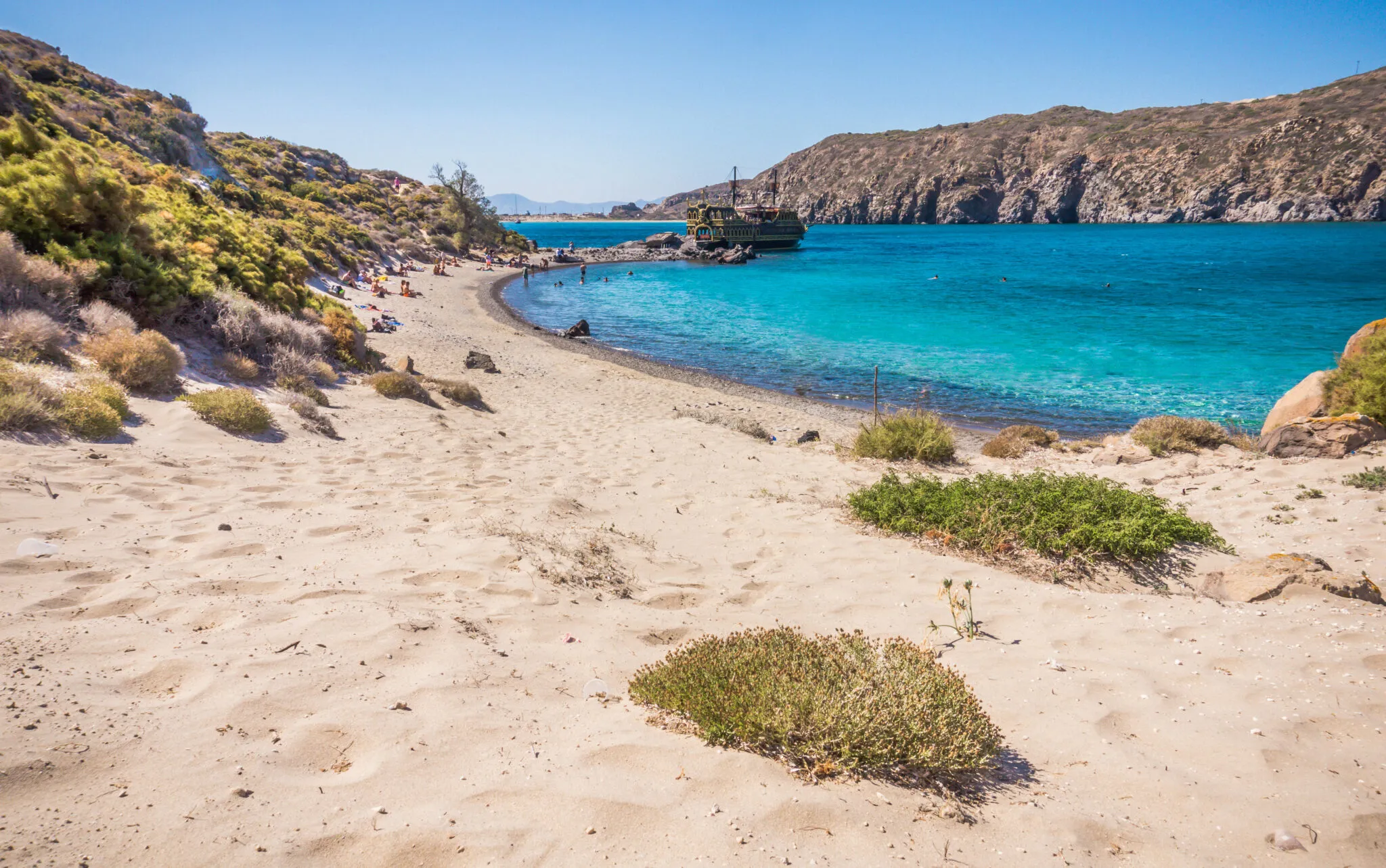
On the eastern side of Nisyros, Pachia Ammos is one of the island’s most striking and quietly unforgettable beaches — a long, wild sweep of dark volcanic sand set beneath an open, elemental landscape. Reached most easily by sea or by a footpath beyond Lies beach, it has the feeling of a place deliberately left outside the ordinary rhythm of tourism: no organised rows of umbrellas, no noise, no excess, only black sand, low dunes, clear water, and the raw volcanic character that defines Nisyros at its most beautiful. For travellers arriving by yacht, Pachia Ammos is exactly the kind of beach that makes the island feel like a discovery rather than a destination — remote, dramatic, and intensely peaceful, with the deep blue of the Aegean made even more vivid against the darkness of the shore.
The Volcanological Museum of Nisyros
In the village of Nikia, overlooking the caldera, the Volcanological Museum of Nisyros gives essential context to the extraordinary landscape that surrounds it. Housed in the village’s former school, the museum explains the formation of volcanoes, the volcanic history of Greece, and the particular geological story of Nisyros itself through models, diagrams, photographs, and accessible scientific material. After walking through the caldera or standing on the rim above Stefanos crater, a visit here deepens the experience: the island is no longer simply beautiful or unusual, but understood as a living geological monument shaped by forces still present beneath the surface. Small, focused, and perfectly positioned in one of the Dodecanese’ most beautiful villages, the museum turns the volcanic drama of Nisyros into something both memorable and meaningful.
Why Choose Nisyros
Nisyros is the island for the traveller who wants to be genuinely surprised. In a corner of the Aegean where the landscape can sometimes feel familiar — white houses, blue sea, stone churches — Nisyros offers something that has no parallel elsewhere in Greece: a living volcano, a lunar caldera, thermal springs emerging from the sea, and black rock beaches unlike anything in the islands. The geological drama here is real, immediate, and deeply humbling, and it gives even the most well-travelled visitor the sensation of encountering something for the first time.
For those arriving by yacht, Nisyros has a particular and very practical magic. The majority of visitors to the island arrive by day-trip ferry from Kos, spend a rushed few hours at the caldera, and leave again before sunset. By the late afternoon, the island is returned to its permanent residents and to those fortunate enough to be anchored in Mandraki harbour or the bay at Paloi. The evening Nisyros — quiet lanes, local tavernas, the extraordinary light on the caldera hills, the stars undimmed by any significant light pollution — is an experience available almost exclusively to those who arrive by sea and choose to stay. It is one of the most rewarding overnight anchorages in the entire Dodecanese.
What makes Nisyros ultimately unforgettable is not any single thing but the totality of it: the combination of volcanic drama and village gentleness, of geological wonder and human warmth, of a landscape that feels like the edge of the world and a community that makes you feel entirely at home within it. This is an island with no pretensions and no need of them — its natural theatre is so complete, so original, and so freely given that it requires nothing added and nothing explained. You sail in, you look around, and you understand immediately why those who discover Nisyros almost always come back.