Why Milos
There are islands that justify the word extraordinary without apology and without exaggeration — islands whose combination of natural beauty, geological drama, mythological depth, and sheer visual astonishment is so complete and so concentrated that the word feels not like hyperbole but like the only honest description available. Milos is this kind of island. The southwesternmost of the Cyclades, lying at the end of the western chain below Sifnos and Kimolos in a sea of particular brilliance and clarity, Milos is a volcanic island of 150 square kilometres whose extraordinary geological history has produced a coastal landscape of such variety, such colour, and such dramatic sculptural beauty that it was voted the best island in the world by the readers of Travel and Leisure magazine in 2021 — a judgement that those who know it well consider not flattering but simply accurate. Over 70 beaches, each of entirely distinct character. A coastline of 126 kilometres of coloured volcanic cliffs, sea caves, lunar rock formations, and hidden coves accessible only from the water. One of the largest natural harbours in the Mediterranean. The discovery site of the most famous sculpture in the ancient world. And a food culture and village life of quiet, genuine, entirely Cycladic excellence that anchors all the geological drama in the warmth and the pleasure of the best possible Greek island experience.
The island’s most ancient distinction is its obsidian — the volcanic glass formed by the rapid cooling of the same lava flows that built the island’s extraordinary landscape, and harvested from the slopes of its central massif since the Early Neolithic period in a trade that made Milos the first significant commercial hub in the prehistoric Aegean. Obsidian from Milos — the finest and most workable natural cutting material available in the prehistoric Mediterranean — has been found at archaeological sites across the entire Aegean and eastern Mediterranean, from the Neolithic settlements of mainland Greece to the Bronze Age cities of Crete and Anatolia, testament to a trading network of remarkable extent and remarkable antiquity that gave the island, eleven thousand years ago, an economic significance and an outward-facing commercial energy that it has never entirely lost. That ancient prosperity funded, in the later periods of antiquity, a civic life of considerable ambition: the Bronze Age settlement of Phylakopi, in the northeastern part of the island, is one of the most important prehistoric sites in the Aegean. The ancient theatre of Milos, cut into the hillside above the village of Tripiti, looked out over a harbour that was, in the Hellenistic and Roman periods, one of the busiest in the western Cyclades. And in the field above that theatre, in April 1820, a farmer named Yorgos Kentrotas and a French naval officer named Olivier Voutier uncovered in the earth of Milos the statue of the goddess Aphrodite that the world now knows as the Venus de Milo — the most celebrated ancient sculpture in existence, its arms missing and its authorship debated, housed since 1821 in the Louvre in Paris.
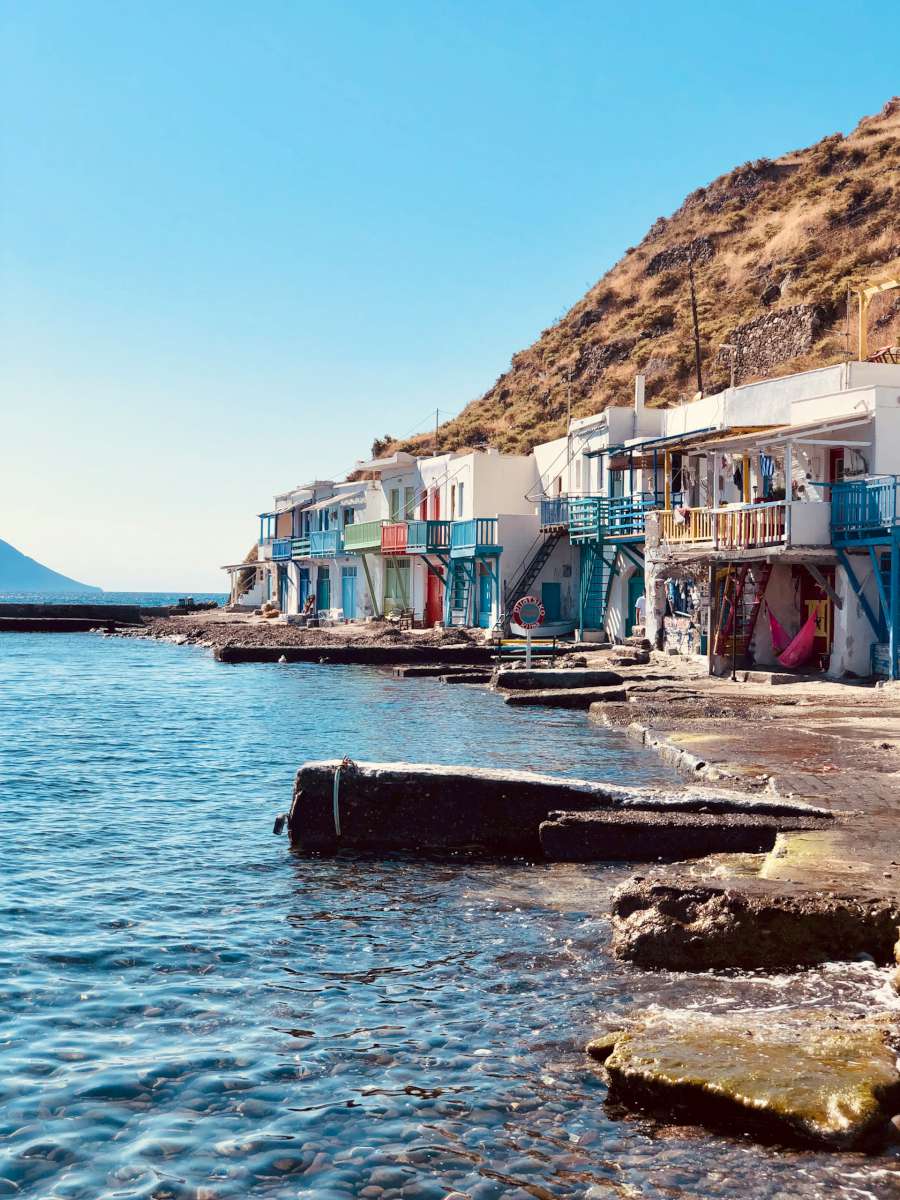
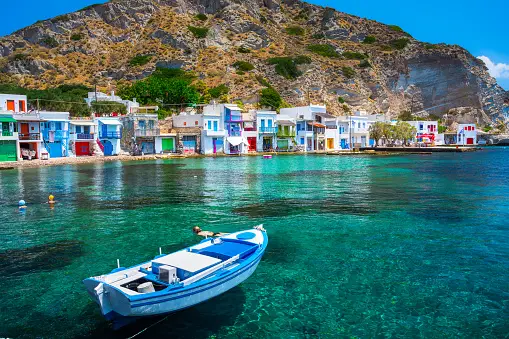
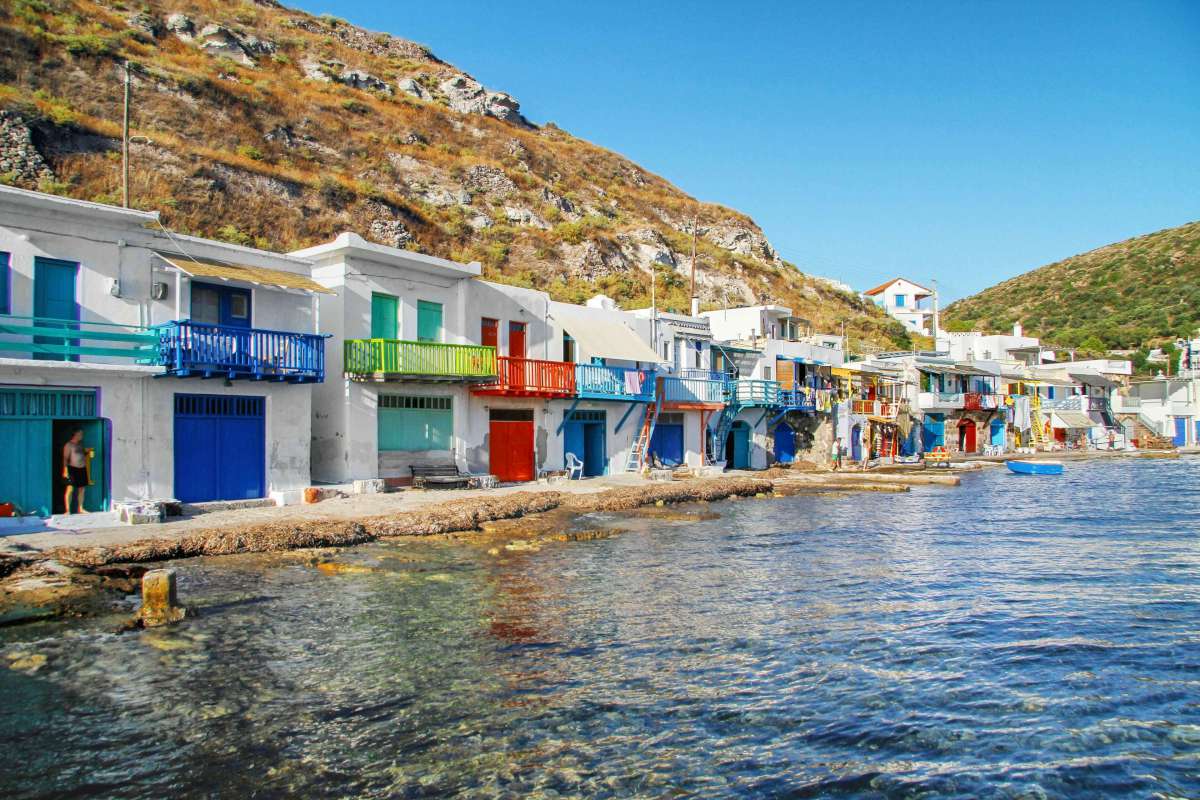
The island’s most immediate quality, on the first approach by sea, is its colour. Milos is an island of extraordinary chromatic variety — the volcanic geology of its coastline producing cliffs and formations of white, cream, orange, red, ochre, grey, and black that alternate along the shoreline in a sequence of colour so vivid and so completely unexpected that it gives the island, even from a distance, a visual character unlike any other in the Cyclades. The fishermen’s houses at Klima, their facades painted in primary colours and their boat garages opening directly onto the sea, are the most photographed example of this chromatic vitality, but the entire coastline of Milos — from the moon-white pumice formations of Sarakiniko in the north to the multi-coloured volcanic cliffs of Kleftiko in the southwest — is a continuous gallery of geological colour and geological form of overwhelming natural beauty. It is this colour — this sense of an island that exists in a permanently heightened register of visual experience — that makes Milos, for those who know the Cyclades well, the single most visually astonishing island in the group.
What to Do and What to See
Milos is an island that rewards a minimum of three days of unhurried exploration — enough time to see its most celebrated natural features by boat, to walk its villages and visit its historical monuments, and to eat well enough in its excellent tavernas to begin to understand why its food culture, less celebrated than that of Sifnos but of entirely comparable quality, is one of the finest and most genuinely pleasurable in the western Cyclades.
Sarakiniko — The Lunar Landscape
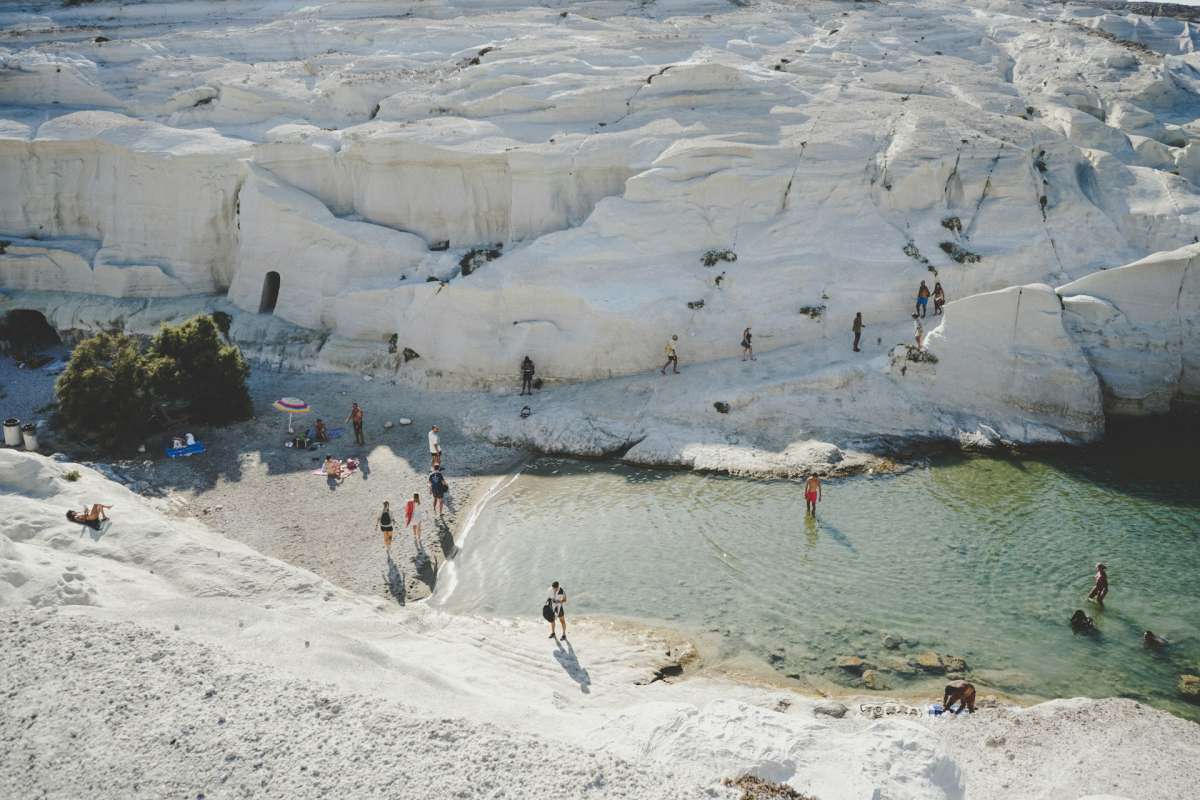
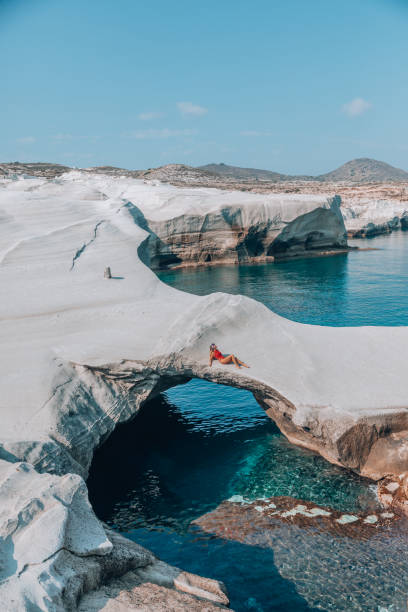
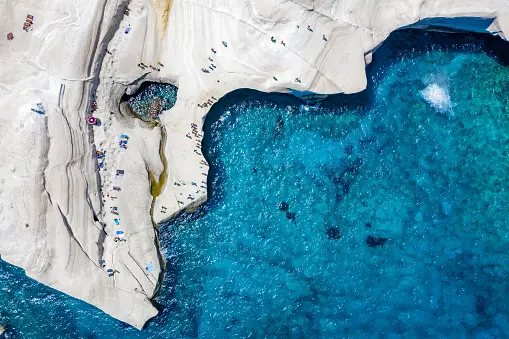
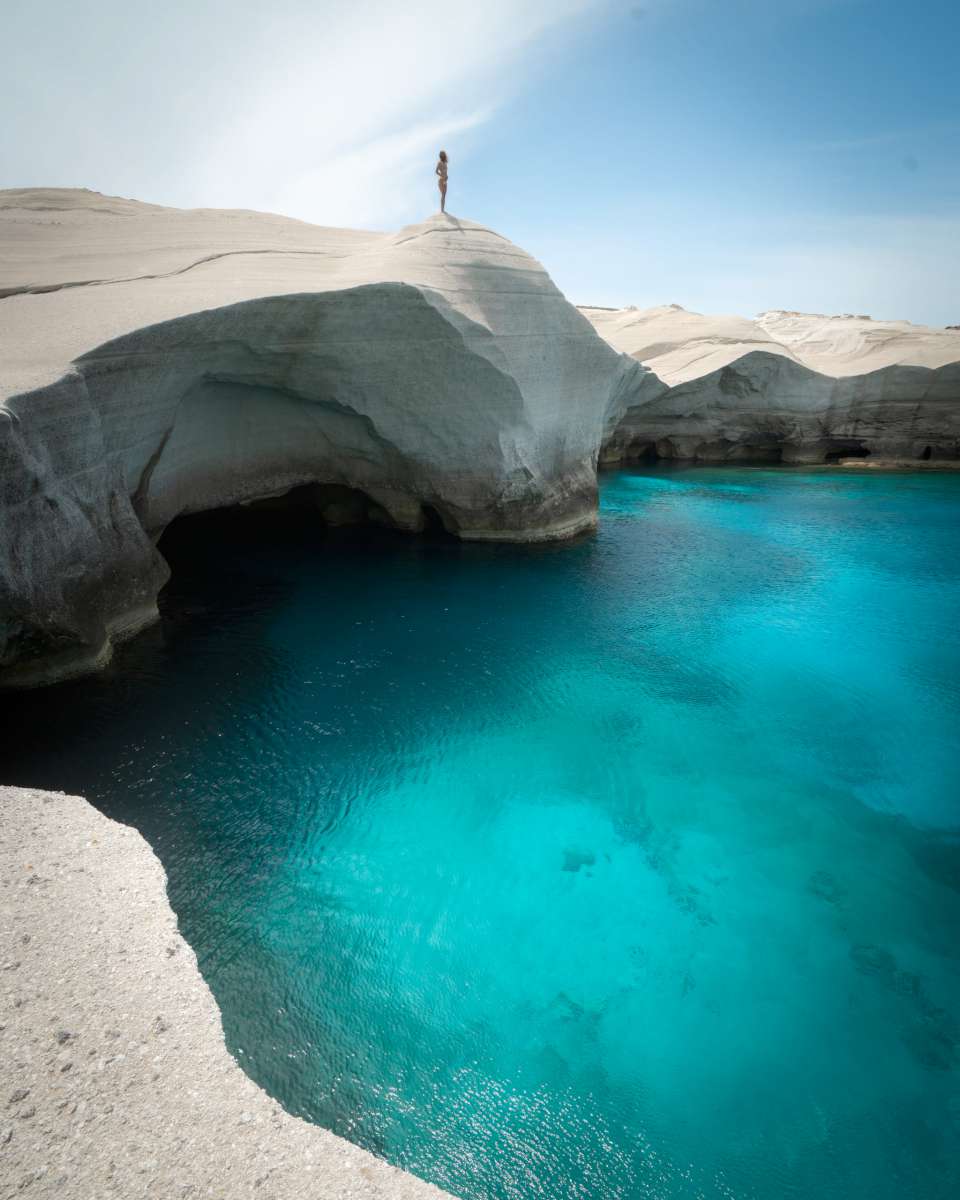
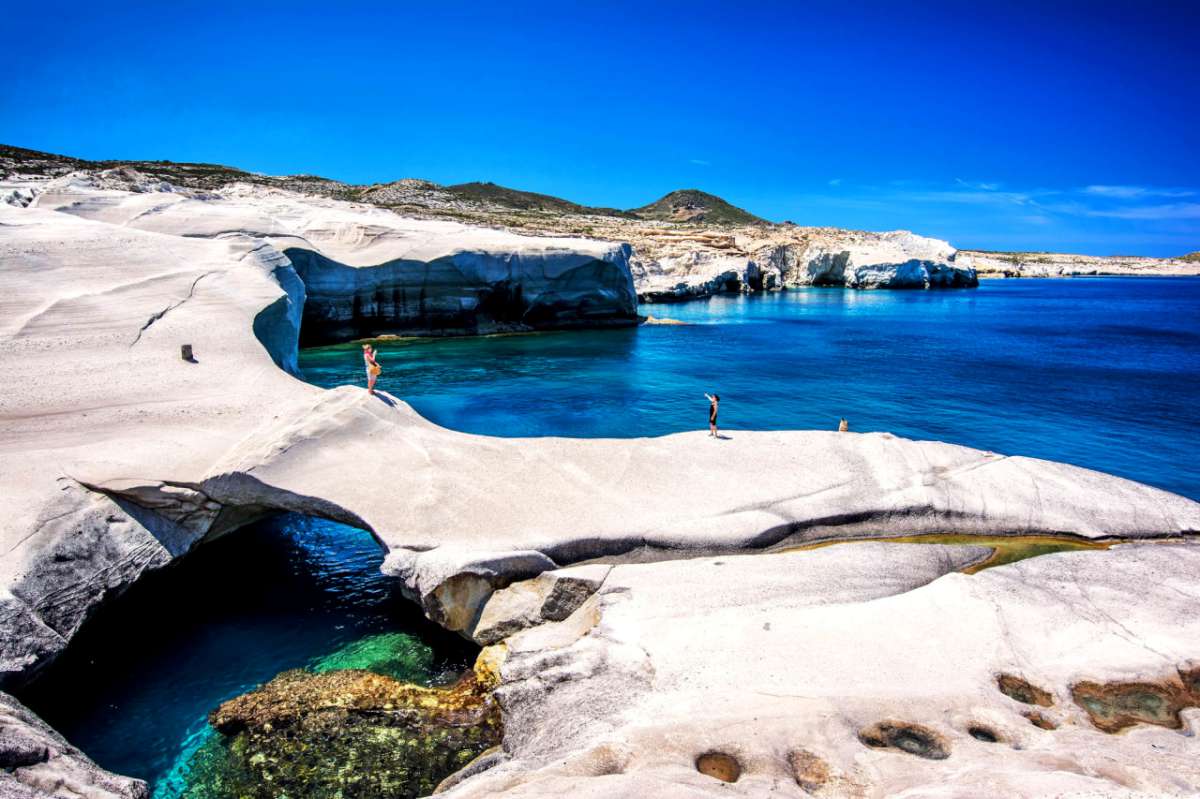
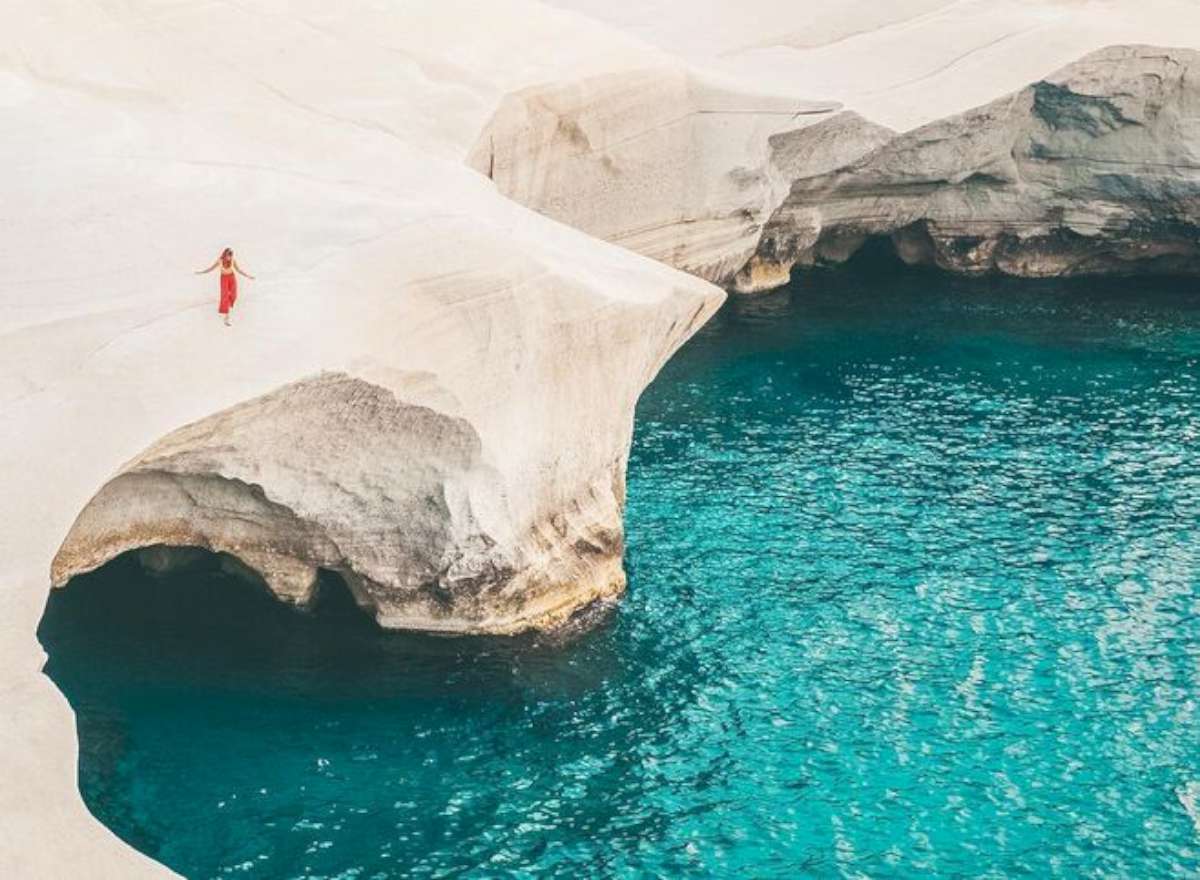
On the northern coast of Milos, the beach and rock formation of Sarakiniko is the most iconic and most completely extraordinary natural feature in the Cyclades — a landscape of smooth, white volcanic pumice, eroded by wind and sea into a series of organic, wave-like forms of such sculptural beauty and such complete visual strangeness that standing in it feels not like standing on a Greek beach but like standing on the surface of another planet. The white pumice of Sarakiniko was deposited by submarine volcanic eruptions and shaped by millennia of Aegean wind and wave into the flowing, rounded formations that give the landscape its distinctive lunar quality. The natural swimming pool formed where the pumice meets the sea — sheltered, clear, and of the most extraordinary colour — is one of the finest natural swimming environments in the Cyclades. The experience of arriving at Sarakiniko in the early morning, before the day visitors arrive, and having its extraordinary lunar landscape in complete silence is one of the most completely memorable natural experiences available on any island in the entire Aegean.
Kleftiko — The Sea Caves of the Southwest
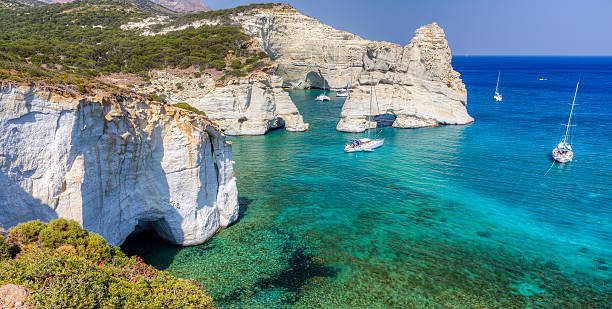
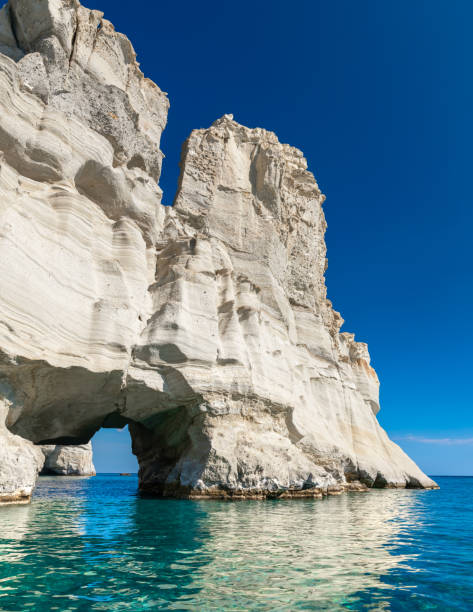
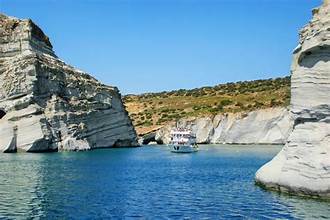
On the southwestern coast of Milos, accessible only by boat, the sea cave complex of Kleftiko is the most spectacular coastal geological feature in the Cyclades and one of the finest boat destinations in the entire Aegean. A cluster of enormous white volcanic rock formations, sea arches, grottoes, and caves of extraordinary scale and extraordinary beauty, Kleftiko takes its name — “the thieves’ place” — from the pirates who historically used its hidden coves and invisible anchorages as a base of operations in the medieval and Ottoman periods. The interior of the cave complex, approached by small boat or by swimming through the arched entrances, reveals chambers of extraordinary natural beauty — the light filtering through openings in the rock above and reflected from the turquoise water below creating colour combinations of the most intense and most completely improbable beauty. Approaching Kleftiko from the sea on a calm morning, with the enormous white rock formations rising from a perfectly still, perfectly clear sea of brilliant turquoise, is one of the finest and most completely overwhelming natural spectacles available to the sailing visitor in the western Cyclades.
The Fishing Villages — Klima, Mandrakia, Firopotamos
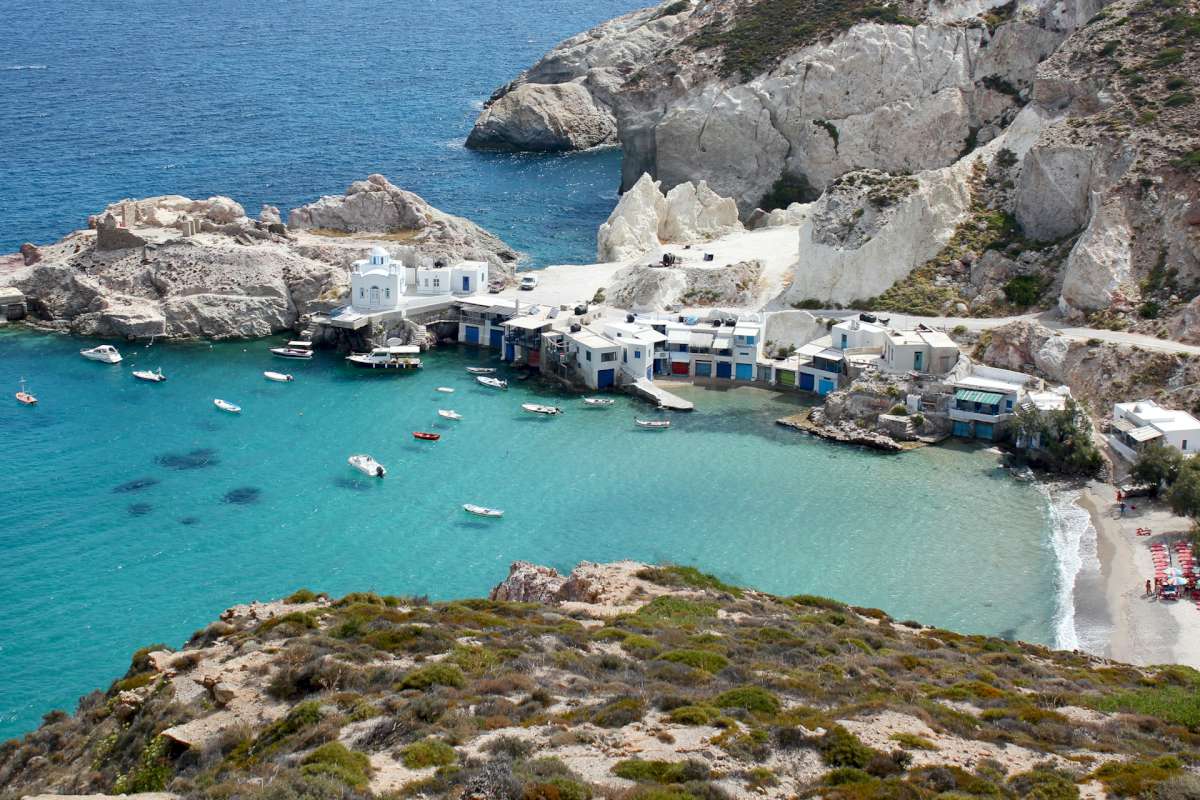
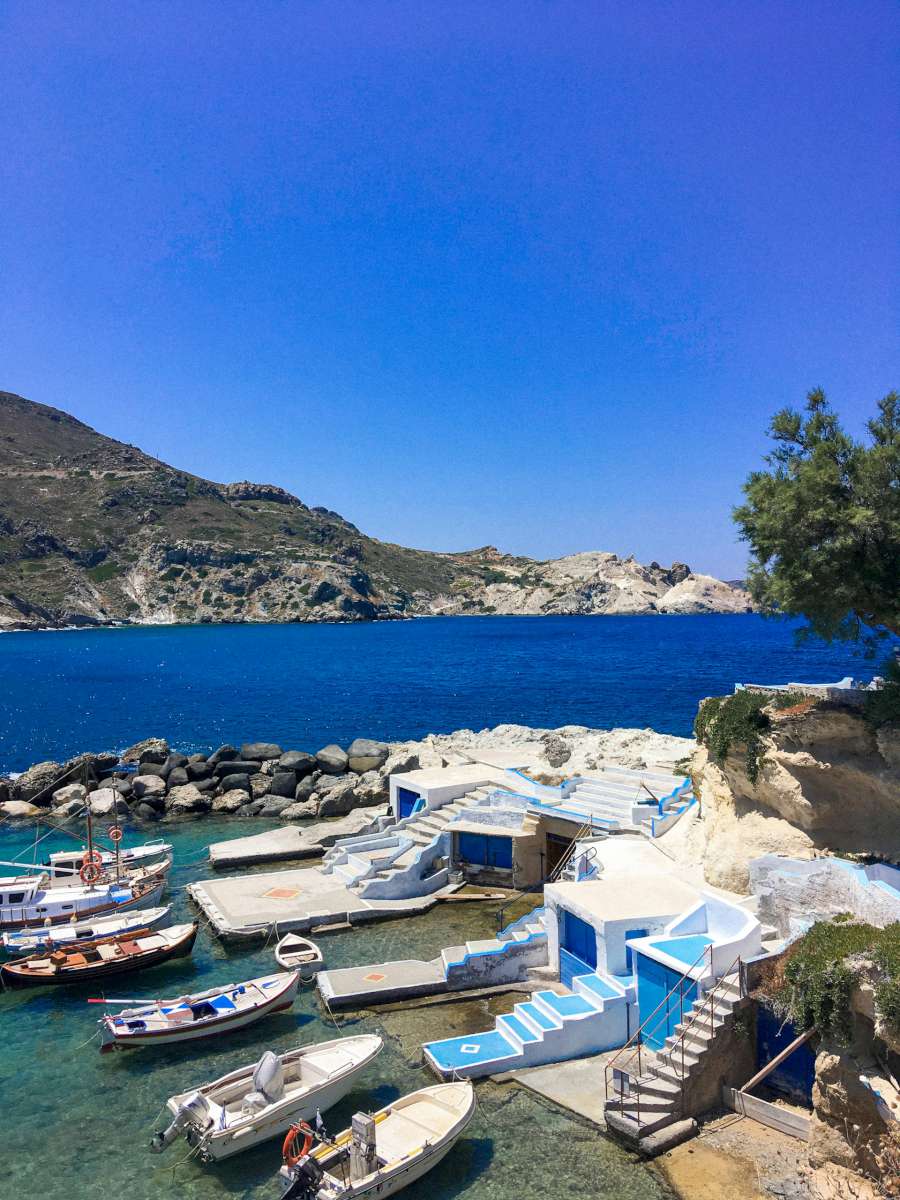
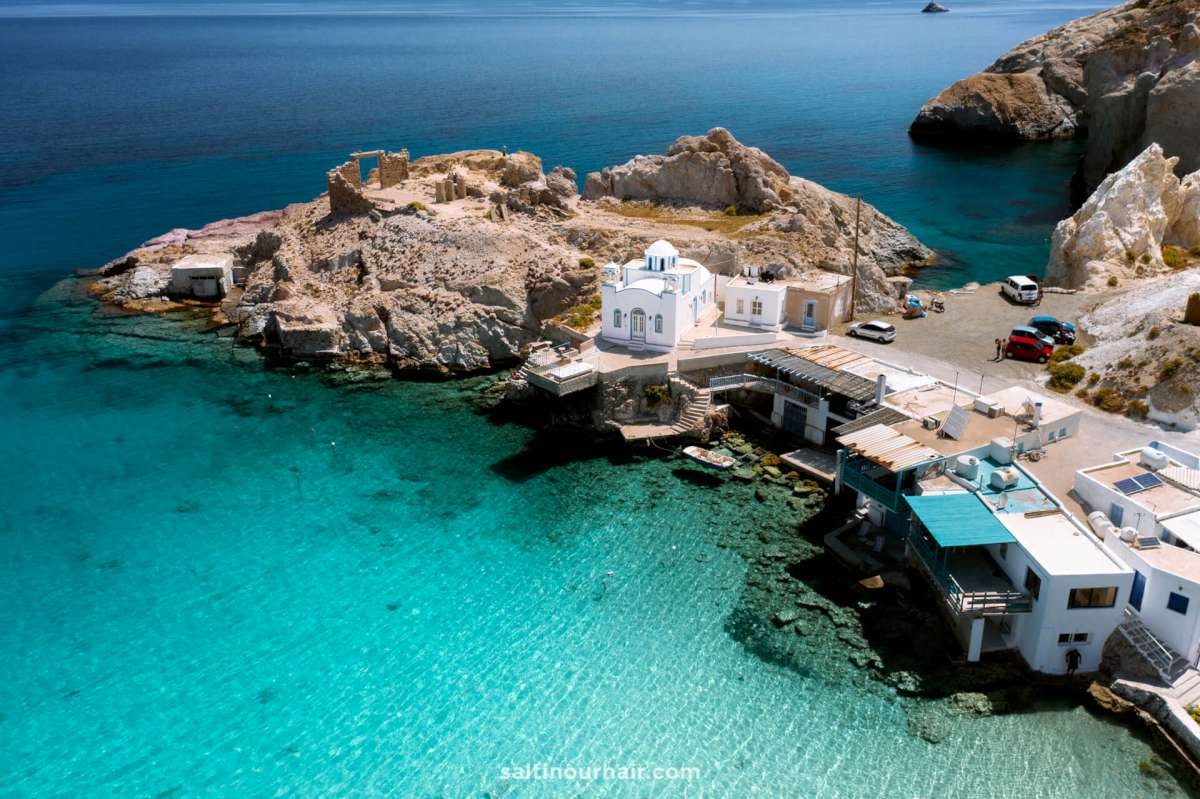
Among the most distinctive and most completely characteristic features of the Milos coastline are its syrmata — the traditional fishermen’s houses built directly at the water’s edge, their brightly coloured facades concealing boat garages that open onto the sea, their upper floors used as summer accommodation and their overall composition creating some of the most vivid and most completely charming harbour scenes in the Cyclades. Klima, directly below the ancient theatre and the village of Tripiti, is the largest and most famous of the syrmata villages — its row of red, blue, orange, and yellow facades reflected in the perfectly calm water of the bay below in a composition of such complete natural elegance that it has become one of the most reproduced images of the Greek islands. Mandrakia, on the northern coast, is smaller and quieter, its syrmata of great beauty in a more sheltered bay. Firopotamos, on the northwestern coast, is perhaps the most completely beautiful of all — a tiny, perfectly enclosed bay of greenish water surrounded by the coloured volcanic cliffs of the island’s western face, its handful of syrmata houses composing a picture of such intimate and such completely natural perfection that it feels, on first encounter, almost too beautiful to be real.
Plaka and Tripiti — The Island Capital
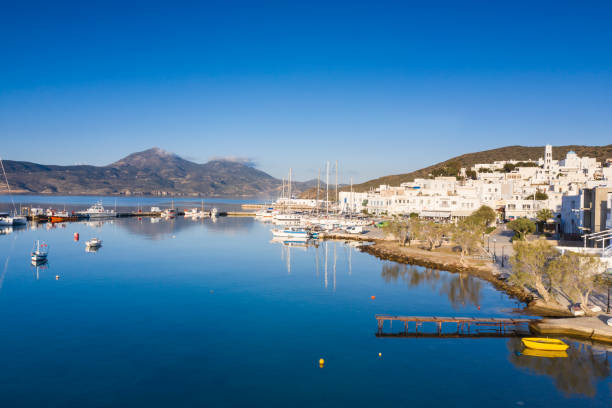
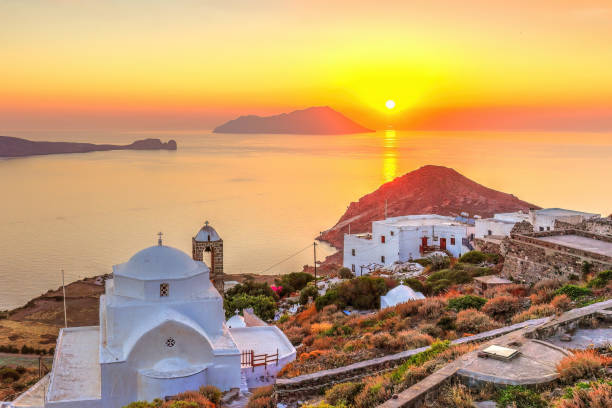
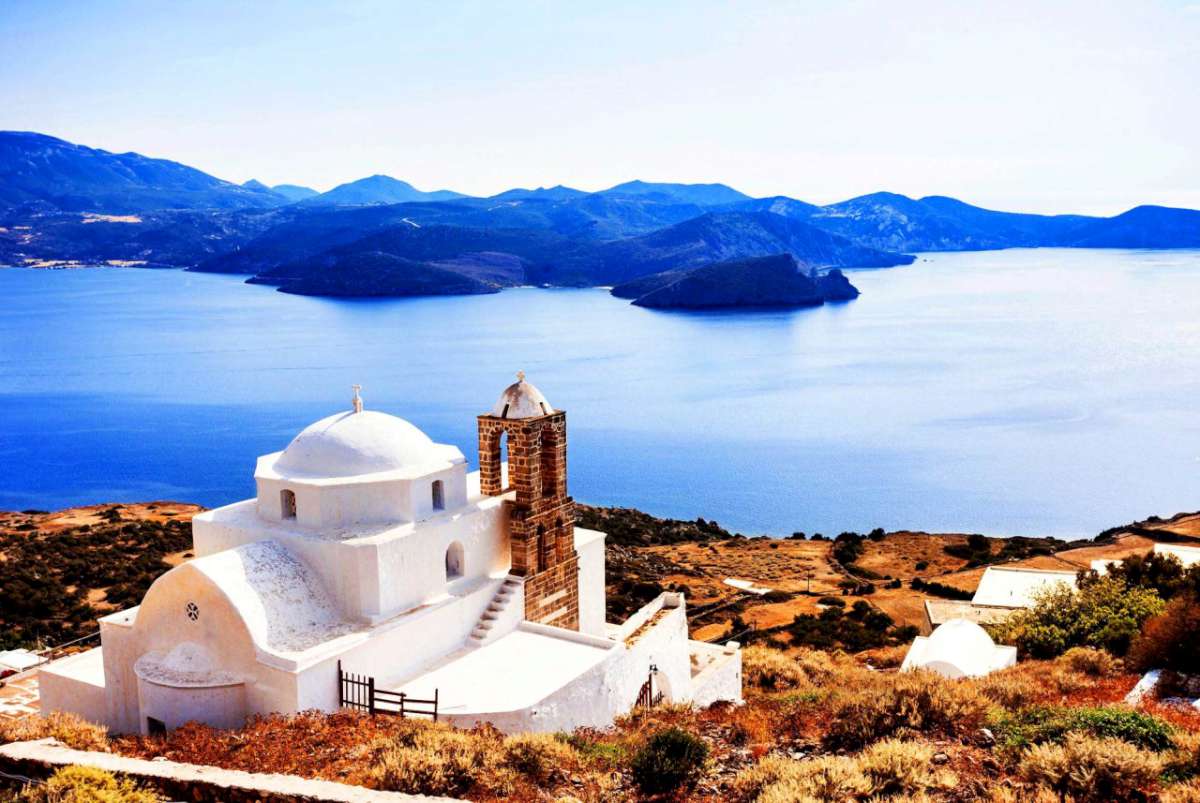
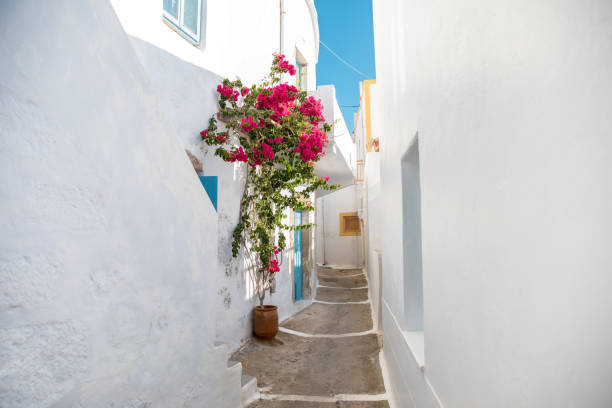
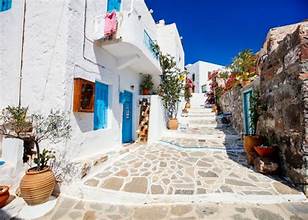
The capital of Milos — Plaka — is a hilltop village of great Cycladic beauty set on the crest of the ridge above the port of Adamas, its white houses and blue-domed churches composing the classic Cycladic townscape with particular completeness and particular grace. The ruined Venetian castle at the summit of the hill above Plaka commands one of the finest sunset views in the western Cyclades — the entire arc of the island’s great natural harbour visible below, with Kimolos and the open sea beyond. The adjacent village of Tripiti, set on the slope below the ancient theatre, contains the island’s most important and most moving historical monument: the early Christian Catacombs of Milos, cut into the volcanic rock of the hillside in the 1st to 5th centuries AD and preserving a network of underground burial galleries of great extent and great historical significance. With over 2,000 burials in five galleries extending 185 metres into the rock, the Catacombs of Milos are among the most important early Christian sites in the Mediterranean world — comparable in significance to the catacombs of Rome and the Holy Land — and the experience of walking through them by torchlight, the niches of the ancient dead on either side and the silence of the volcanic rock above, is one of the most profound and most completely affecting historical experiences available on any Greek island.
The Ancient Theatre and the Site of the Venus de Milo
Above Tripiti, the ancient theatre of Milos is a small but beautifully preserved Hellenistic structure whose marble seating tiers look out over the great natural harbour of the island and the sea beyond in a view of extraordinary beauty and considerable historical resonance. A short walk above the theatre, a simple marker in the earth of the hillside indicates the approximate spot where, in April 1820, the farmer Yorgos Kentrotas uncovered the marble statue that the world now knows as the Venus de Milo. The original is in the Louvre; a copy stands in the Archaeological Museum of Milos in Plaka. But the site itself — the unremarkable field, the view of the harbour below, the knowledge of what was found here — has a quality of quiet historical significance entirely characteristic of Greece at its most genuinely and most movingly historical.
The Beaches
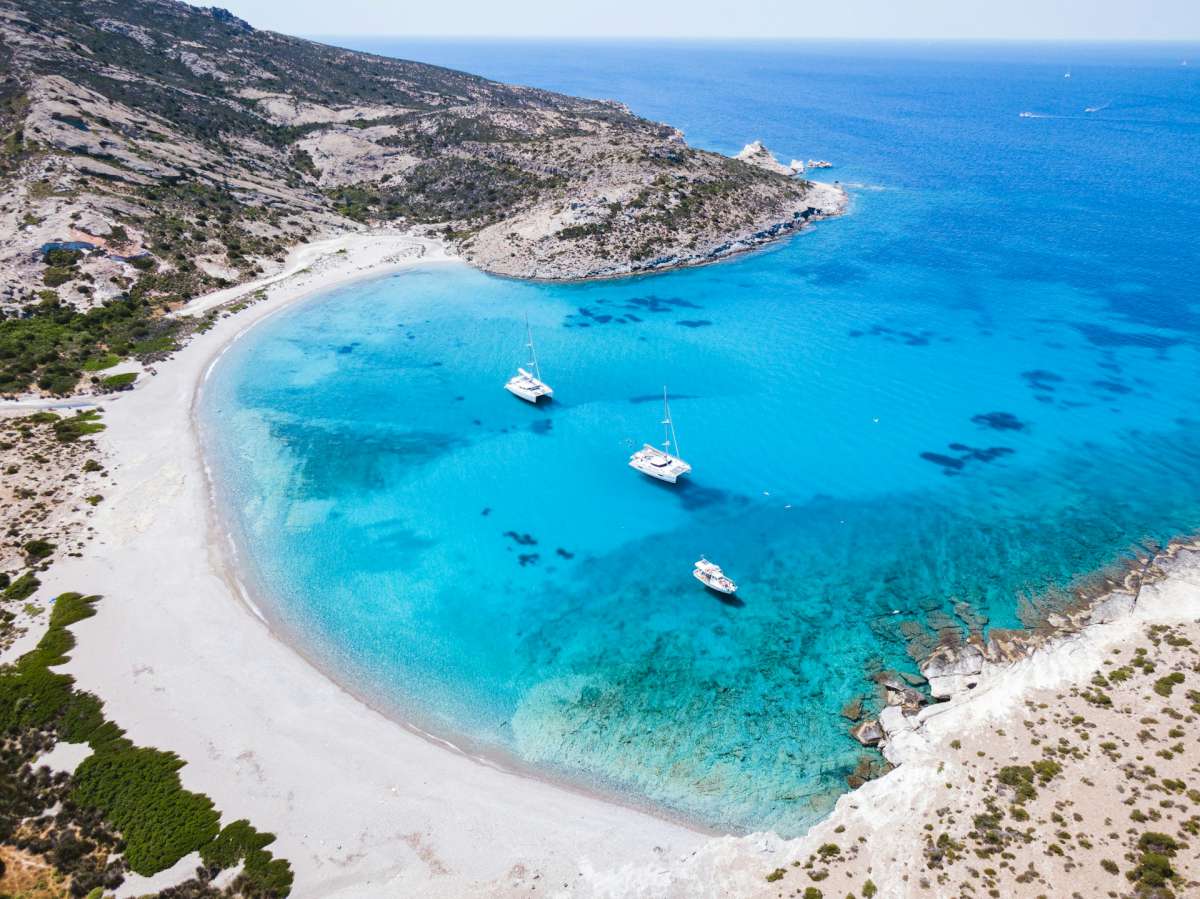
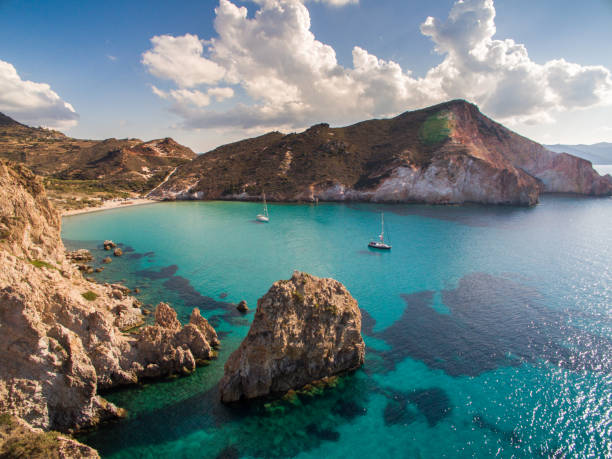
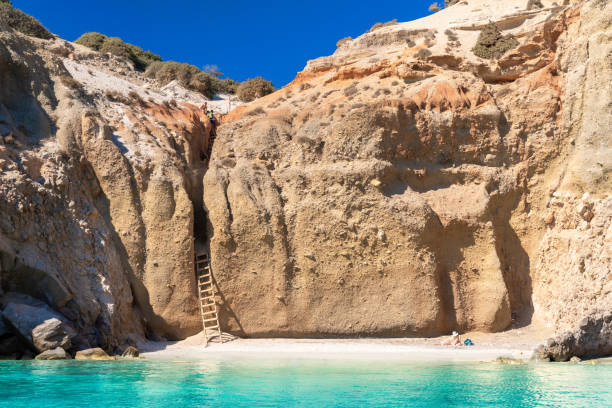
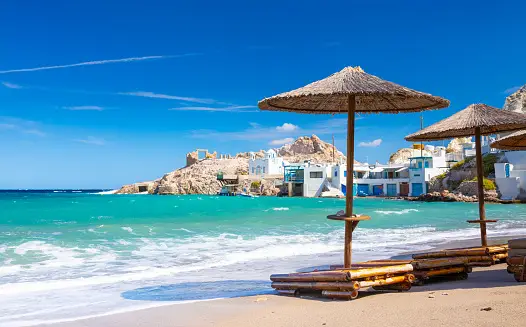
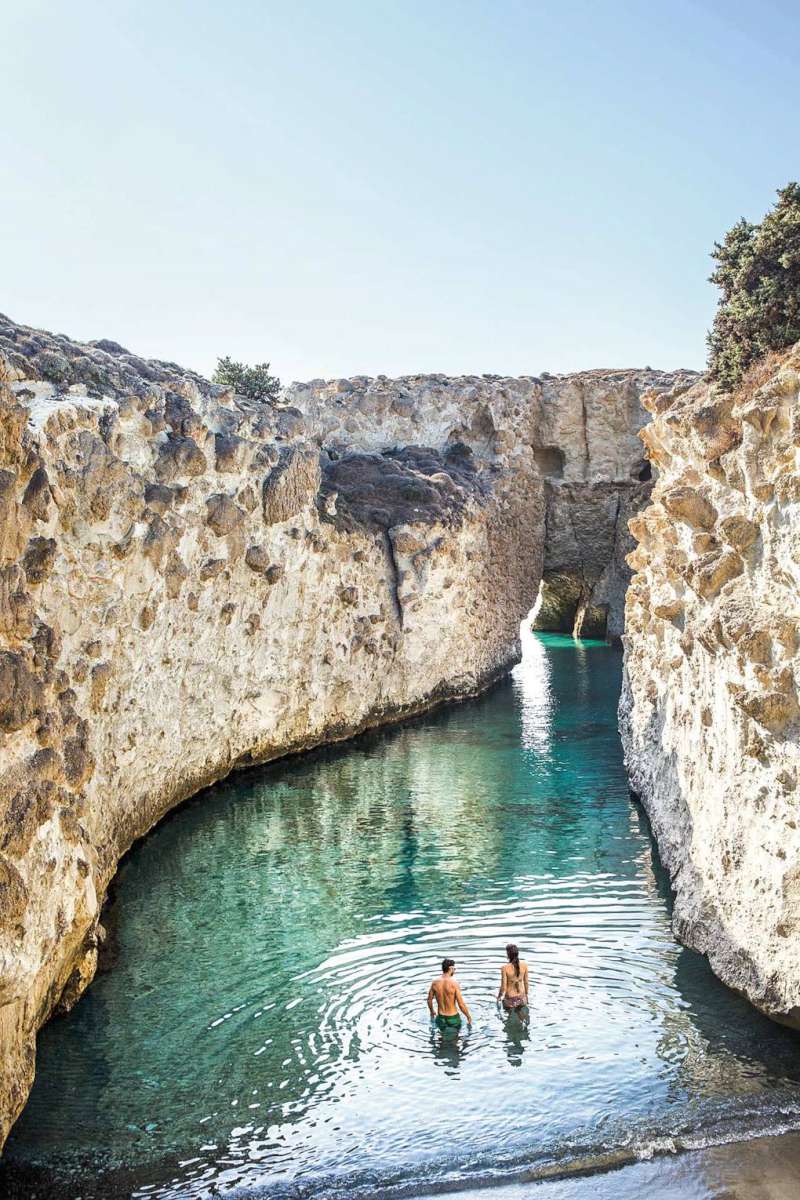
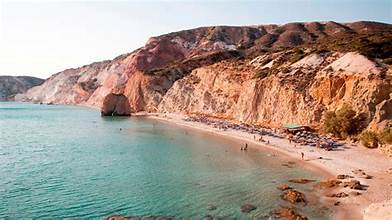
Milos has over 70 beaches distributed around its extraordinary 126-kilometre coastline, each of entirely distinct character and each shaped by a different expression of the island’s volcanic geology. Firiplaka, on the southern coast, is a long beach of pale sand backed by multi-coloured volcanic cliffs of extraordinary beauty — its combination of fine sand, clear water, and the coloured rock formations above it making it one of the most visually spectacular beach settings in the Cyclades. Tsigrado, on the southern coast, is a hidden cove accessible by ladder and by rope through a narrow crevice in the cliff above — its inaccessibility ensuring a degree of solitude and a quality of natural beauty entirely worth the minor adventure of the descent. Papafragas, on the northern coast, is a sea cave beach of great drama, its narrow inlet accessible by swimming through a low cave entrance into a chamber of volcanic rock with a small sandy beach at its inner end. And Paleochori, on the southeastern coast, is a beach of hot volcanic springs rising from the sand itself — the water perceptibly warm underfoot, the volcanic heat of the island rising directly through the beach into the feet of those who walk it.
Why Choose Milos
Milos is the island for every traveller who wants the most completely astonishing natural landscape in the Cyclades — the most dramatic volcanic coastline, the most extraordinary beaches, the most varied and most spectacular boat destinations in the western group — in a setting of genuine Cycladic village beauty, excellent food, and the particular warmth of an island that has been welcoming visitors of discernment for long enough to do it with complete confidence and complete ease. It is for those who want to arrive at Kleftiko in the morning light by small boat and swim through the sea caves in water of impossible colour. For those who want to stand at Sarakiniko at dawn and understand, for the first time, why people call Milos the most beautiful island in the world. For those who want to eat fresh seafood at a table in Adamas with the great natural harbour of Milos stretching out before them in the evening light, and understand why this island, for all its geological drama, is ultimately a place of the most completely human scale and the most completely genuine Cycladic pleasure.
For sailing itineraries in the western Cyclades, Milos is the natural culmination of the western chain — the island that justifies the entire passage from Piraeus through Kythnos, Serifos, Sifnos, and Kimolos with a destination of such outstanding quality and such extraordinary variety that the sailor who arrives here after days of western Cycladic sailing has the entirely satisfying experience of arriving at exactly the right place at exactly the right time. The great natural harbour at Adamas is one of the finest and most completely protected anchorages in the Cyclades. The coastline of Milos — explored by dinghy over three or four days of unhurried cruising — is the most spectacular single coastline in the western group.
What Milos ultimately is — and what it has been, with increasing clarity, for every generation of travellers willing to seek out the western Cyclades with the curiosity and the patience the journey requires — is the most visually extraordinary island in the Cyclades, and quite possibly the most beautiful island in the Aegean. The Venus de Milo was found here, and she was made from Parian marble, and her arms are missing, and she is in Paris. But the island itself — the volcanic coastline, the coloured cliffs, the lunar rock of Sarakiniko, the sea caves of Kleftiko, the syrmata of Klima reflected in the perfectly still water of the bay at dawn — is entirely present, entirely intact, and entirely as extraordinary as the most beautiful thing the ancient world ever made from its stone.