Why Kos
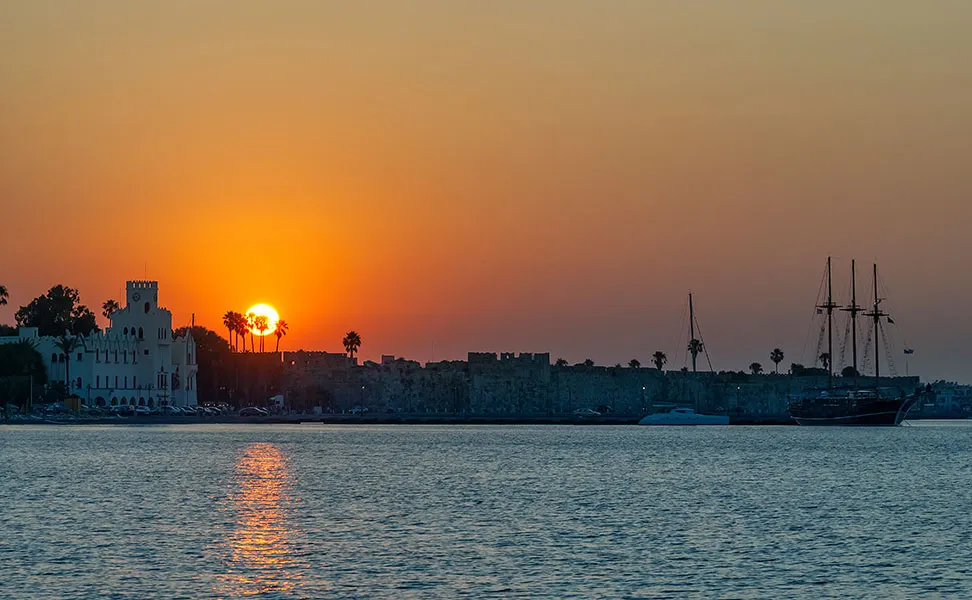
Some islands define themselves through their landscape. Others through their history. Kos, with characteristic Aegean generosity, offers both in abundance — and then adds a warmth of atmosphere and an ease of character that makes it one of the most immediately loveable islands in the entire Dodecanese. Sailing into Kos Town harbour on a clear morning, with the medieval Castle of the Knights rising straight from the water and the minarets and palm trees of the old town visible behind it, you feel at once that you have arrived somewhere that has been welcoming travellers with grace and style for a very long time. That instinct is correct. Kos has been receiving distinguished visitors since antiquity, and it has had thousands of years to perfect the art.
The island sits in the southeastern Aegean, cradled between the Turkish coast — so close you can see its mountains clearly from the Kos shoreline — and the volcanic bulk of Nisyros to the south. It is the third largest of the Dodecanese islands, long and narrow in shape, stretching some 45 kilometres from the bustling harbour capital in the northeast to the wild, windswept tip of Cape Krikello in the southwest. But what gives Kos its singular identity in the Greek world is not its geography or even its medieval monuments — it is a name. Hippocrates, the father of modern medicine, was born on this island around 460 BC, and the shadow of that extraordinary legacy falls across everything. The island’s connection to healing, to the rational observation of nature, and to the proposition that human wellbeing is worth taking seriously has shaped its character in ways both tangible and intangible for two and a half thousand years.
Kos is also, quite simply, beautiful in a way that feels effortless and abundant. Its interior is surprisingly green and fertile — a rolling landscape of cypress and pine, olive groves and vineyards, fragrant with wild herbs in the spring. Its beaches are among the finest in the Dodecanese: long, wide, and blessed with the kind of calm, clear, turquoise water that makes the Aegean famous. And its people carry the characteristic pride of an island that knows its own worth — hospitable without being servile, proud without being unwelcoming, and possessed of a civic culture that keeps even the most popular tourist areas feeling like real, lived-in places rather than stage sets.
What to Do and What to See
Kos rewards exploration at every scale — from an afternoon lost in the lanes of its medieval old town to a full day’s yacht cruise along its remarkable coastline, from a quiet hour sitting beneath the Plane Tree of Hippocrates to a long, sun-drenched morning on one of the island’s world-class beaches. The island’s shape — long and narrow, with the coastline always close — makes it particularly well suited to discovery by sea, and arriving by yacht allows you to approach its most dramatic moments exactly as they deserve: from the water, without crowds, and entirely on your own schedule.
Kos Town and Its Medieval Heart
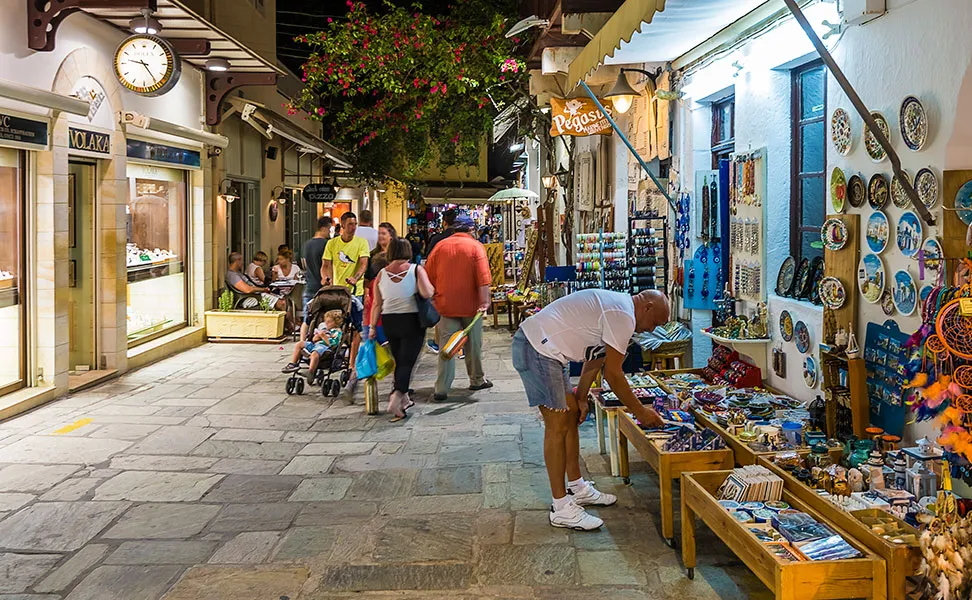
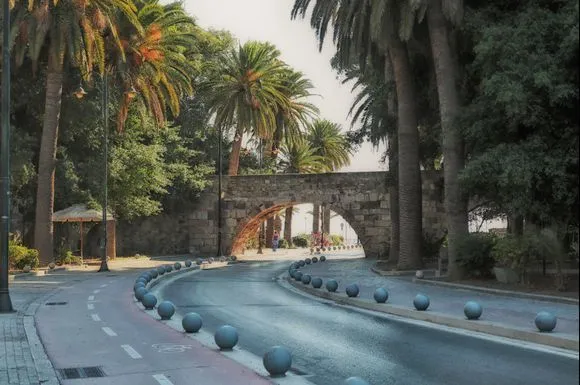
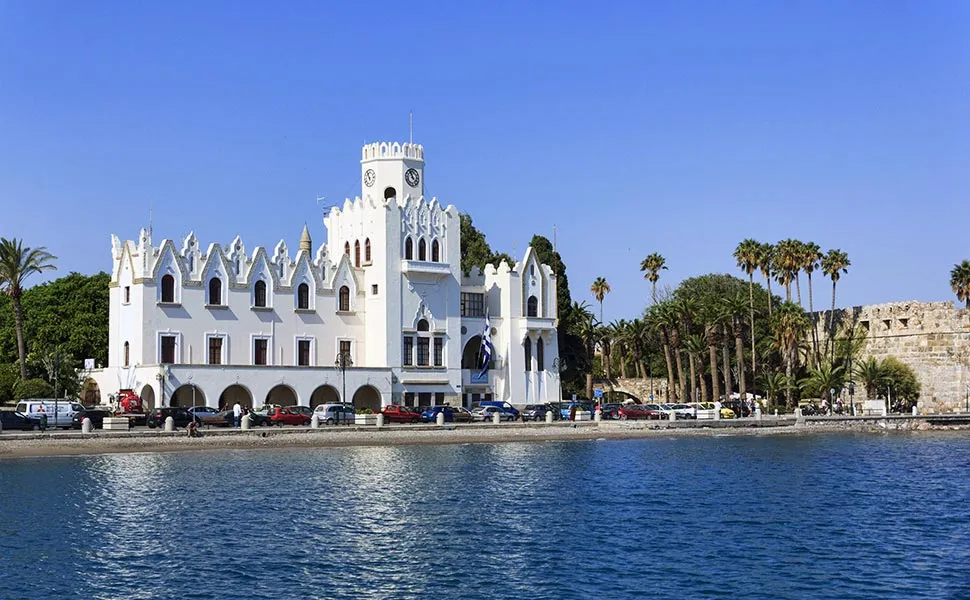
The island’s capital is one of the most elegant and historically layered small towns in the Aegean. At its heart is the Old Town, a tangle of lanes that weaves between Byzantine ruins, Ottoman mosques, Venetian archways, and neoclassical facades left behind by the Italian occupation of the early 20th century — a palimpsest of civilisations that gives Kos Town a depth and visual richness entirely disproportionate to its modest size. The harbour front is lined with cafés and restaurants, the castle reflected in the water beyond, and the atmosphere on a warm summer evening — with the lights of the Turkish coast glittering across the narrow strait — is one of the most romantic in all of Greece.
The Castle of the Knights
Standing directly at the entrance to Kos Town harbour, the Castle of the Knights of St. John is one of the finest and best-preserved Crusader fortresses in the eastern Mediterranean. Built in the 15th century using stone quarried — somewhat controversially — from the ancient ruins of the island, the castle served as the main defensive stronghold of the Knights of Rhodes and withstood multiple Ottoman sieges before finally falling to Suleiman the Magnificent in 1523. Walking its massive walls, you look directly down into the harbour on one side and out across the Aegean toward the Turkish coast on the other. The castle’s interior houses fragments of ancient sculpture and architectural elements embedded in its walls — a strange, haunting collage of civilisations stacked inside one another.
The Plane Tree of Hippocrates
In the square just outside the castle entrance stands one of the most famous trees in the world: the great plane tree under which Hippocrates is said to have taught his students the principles of medicine some 2,400 years ago. The tree itself is ancient — one of the oldest in Europe, with a trunk of enormous girth supported by a system of scaffolding and iron braces — though its true age is the subject of gentle scholarly debate. Whether or not Hippocrates actually sat beneath this precise tree matters rather less than what the sight of it evokes: the extraordinary idea that on this small Aegean island, in the fifth century BC, one man began the project of understanding human health through careful observation and reason rather than superstition. The adjacent Ottoman fountain and mosque complete a scene that is quietly one of the most historically resonant in the Dodecanese.
The Asclepeion
About four kilometres southwest of Kos Town, set on a pine-covered hillside with views across the sea to the Turkish coast, the Asclepeion is the most important ancient monument on the island and one of the most significant archaeological sites in all of Greece. This was the great healing sanctuary of antiquity — a complex of temples, baths, treatment rooms, and colonnaded terraces built in the 4th century BC and dedicated to Asclepius, the god of medicine. Patients came from across the ancient world to be treated here, combining what we might recognise as rational medical care with religious ritual and the restorative power of the natural setting. The ruins spread across three terraced levels, with the upper temple of Asclepius commanding a view so magnificent — pine trees, blue sea, and the distant mountains of Turkey — that the landscape itself feels like part of the cure.
The Ancient Agora
At the heart of Kos Town, the extensive ruins of the ancient Agora spread across a large open site just inland from the harbour. Dating primarily to the Hellenistic and Roman periods, the Agora was the civic and commercial heart of ancient Kos — a vast colonnaded market square surrounded by temples, stoas, and public buildings. The ruins are unusually extensive and evocative for a town-centre site, with columns, mosaic fragments, and carved stonework visible across a wide area. Combined with the adjacent Western Archaeological Site — which includes a Roman odeon still used today for summer performances, a remarkable set of mosaic floors, and the remains of a Roman residential quarter — the ancient heritage of Kos Town amounts to one of the richest open-air archaeological experiences in the Aegean.
Tigaki and the Northern Beaches
The northern coast of Kos between the capital and the centre of the island is fringed with a sequence of long, shallow, sandy beaches that are simply among the finest in the Dodecanese. Tigaki, the closest major beach to Kos Town, stretches for several kilometres in a wide arc of pale sand with warm, calm, turquoise water barely a metre deep for a considerable distance from the shore — making it particularly wonderful for families with young children. Further west, Marmari and Mastichari continue the sequence, each with its own small harbour village and a cheerful, easy atmosphere. Approaching these beaches by yacht along the calm northern coast on a summer morning, with the island’s green interior rising behind and the Turkish mountains visible across the water, is a quietly idyllic experience.
Kefalos and the Wild Southwest
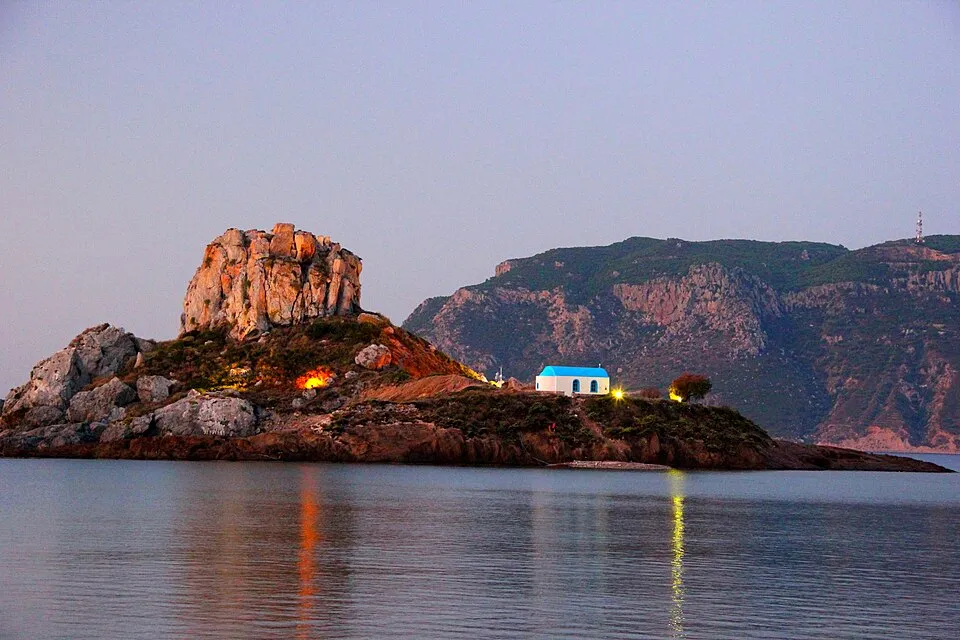
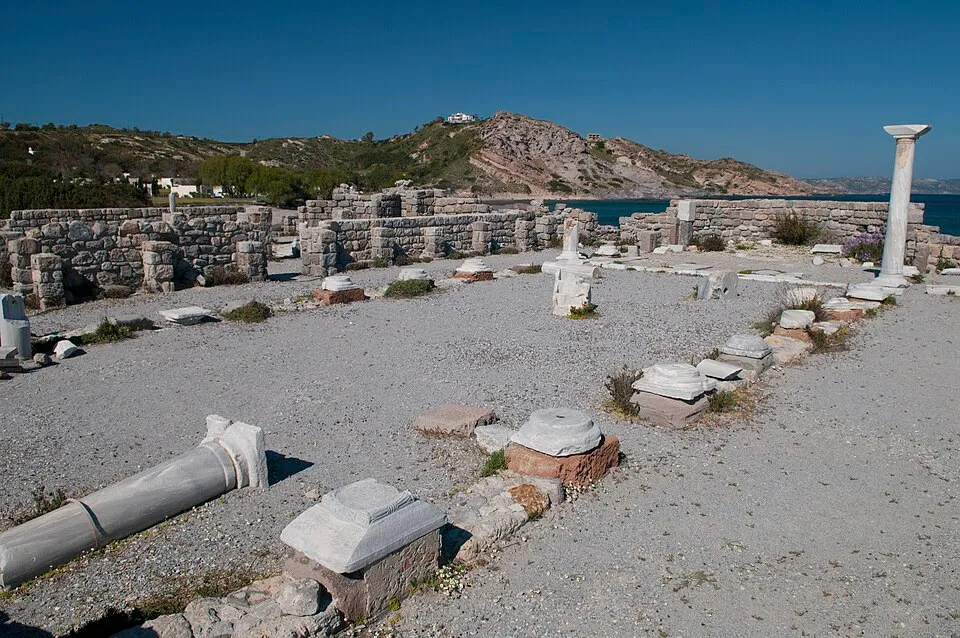
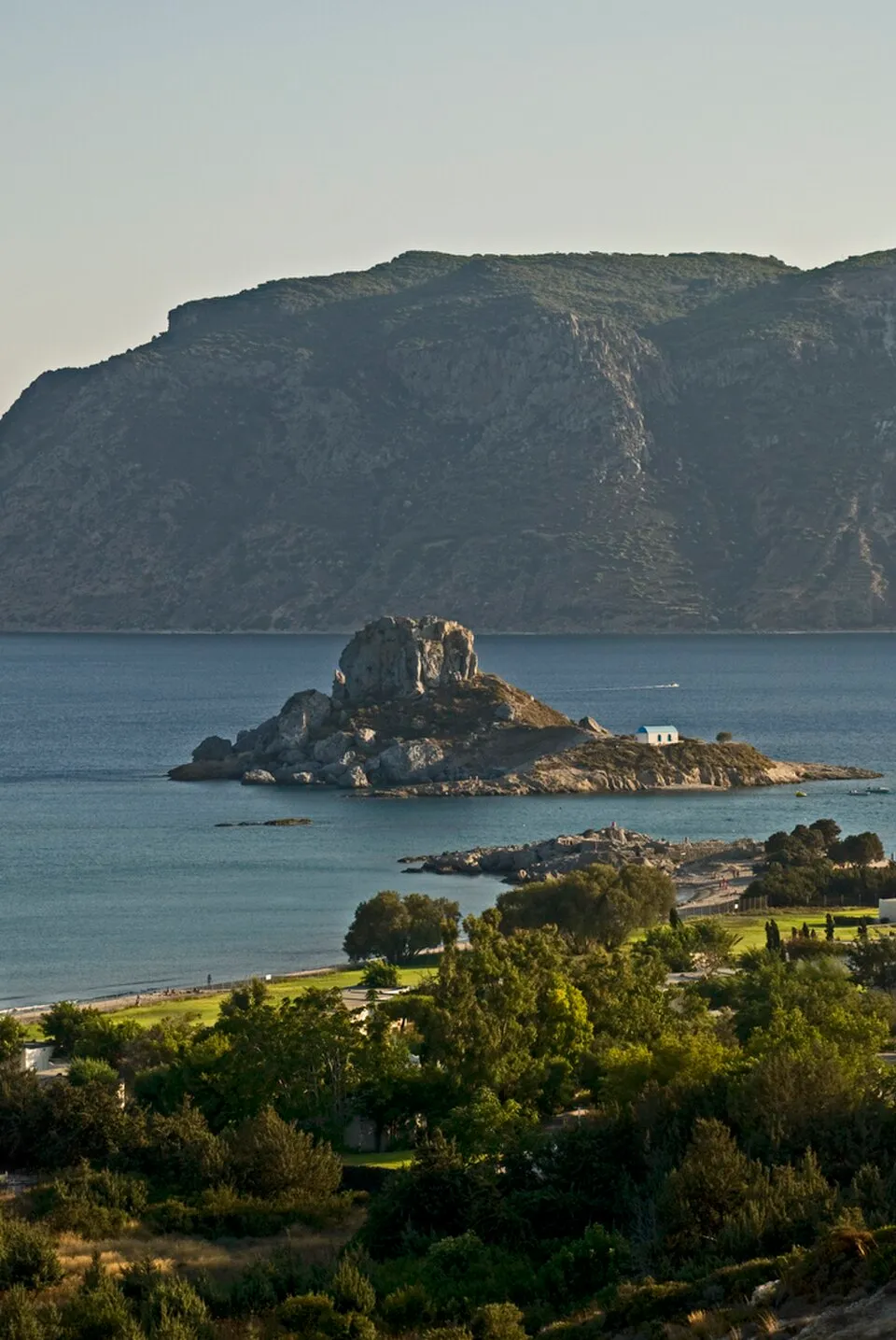
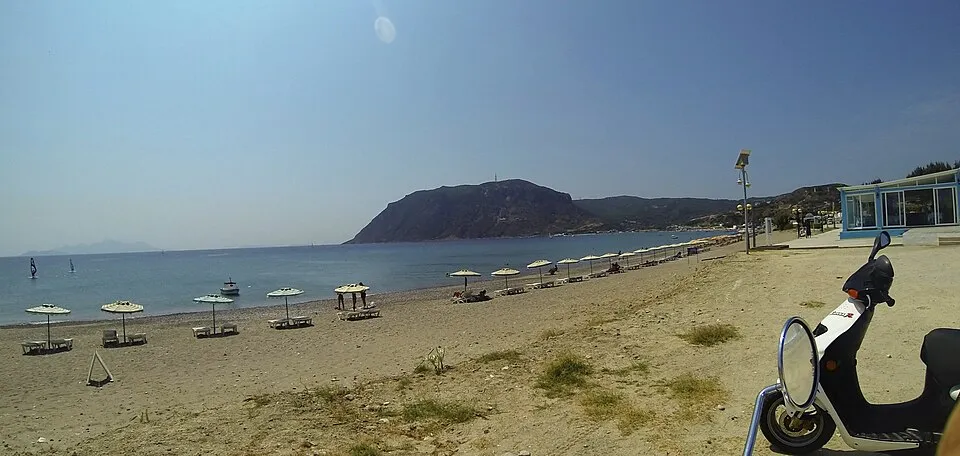
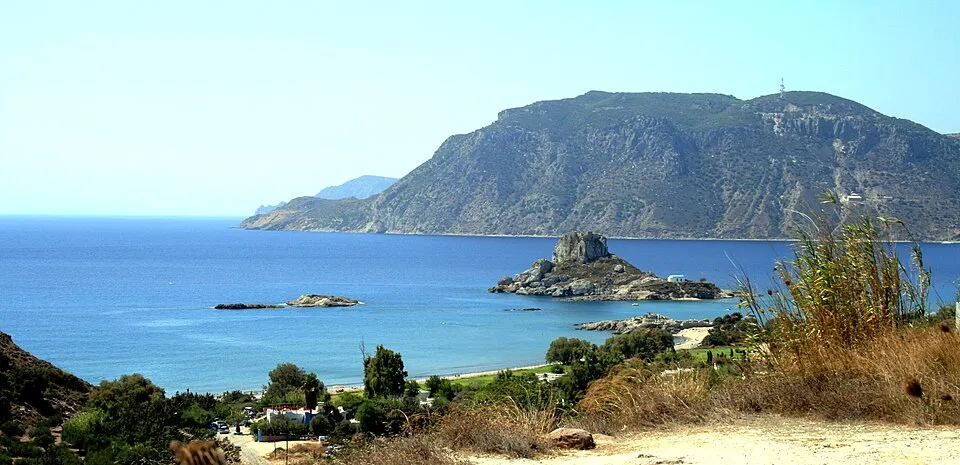
At the opposite end of the island, the southwest is a completely different Kos — wilder, quieter, and far less visited. The village of Kefalos sits high on a rocky promontory above a sweeping bay, its windmill silhouetted against the sky, and the road that descends from it toward the sea passes the ruins of an early Christian basilica, an ancient castle, and the cave church of Agios Ioannis before arriving at the bay of Kamari — a long, uncrowded stretch of sand with the tiny islet of Kastri and its white chapel just offshore, an image so perfectly composed it has become one of the most reproduced views on the island. The beaches of Paradise and Magic further south are accessible by boat and offer superb swimming in remarkably clear water, away from the summer crowds of the north.
Thermal Springs at Embros Therme
On the northeastern coast, about eight kilometres from Kos Town, the natural thermal springs of Embros Therme emerge directly from the rocks at the edge of the sea, creating a series of shallow natural pools where hot mineral water mingles with the cool Aegean in clouds of steam. Bathing here — particularly after sunset when the pools are at their most atmospheric — is one of the island’s most distinctive and memorable experiences, a direct inheritance of the healing tradition that Hippocrates himself would have recognised and approved. The springs are accessible by yacht, with easy anchoring nearby, and the combination of hot spring and cool sea makes for a wonderfully restorative afternoon.
Why Choose Kos
Kos is the island that does everything well, and that ease and versatility is precisely its greatest strength. Families find on its northern coast some of the safest, warmest, most beautiful shallow-water beaches in Greece — broad, sandy, and calm, with the kind of turquoise water that makes children reluctant to come ashore. History lovers find in Kos Town and the Asclepeion a depth of ancient heritage that few Aegean islands can rival. Food lovers find a thriving local taverna culture anchored in the fresh produce of a genuinely fertile island — the vegetables, the olive oil, and the fish are all exceptional. And those seeking beauty and atmosphere find it everywhere, from the castle at the harbour mouth to the wild southwestern cape where the sea wind bends the grass and the views seem to extend forever.
For those arriving by yacht, Kos occupies a perfect strategic position — close enough to Rhodes to be an easy day’s sail, well placed for excursions to the volcanic island of Nisyros and the quiet anchorages of Kalymnos to the north, and possessed of its own harbours and bays of sufficient variety and quality to reward several days of exploration without any sense of having exhausted the island. The combination of an excellent main harbour town with strong facilities, a long and varied coastline, and some of the finest beaches in the Dodecanese makes Kos one of the most practical and pleasurable yacht bases in the southeastern Aegean.
What separates Kos from the simply pleasant and elevates it to the genuinely memorable is the weight and meaning of its history. To stand beneath the Plane Tree of Hippocrates, or to walk the terraces of the Asclepeion looking out across the sea from which the father of medicine once drew his inspiration, is to feel the particular thrill of standing on ground where something important actually happened — where a great mind worked, where a fundamental idea about humanity took shape for the first time. Kos does not wave that heritage loudly or dress it up for effect. It simply carries it, quietly and with natural dignity, as it has for two and a half thousand years. That quiet confidence, more than any beach or any monument, is what makes this island truly worth sailing to.