Why Epidaurus
There are destinations that resist easy description — not because they are obscure or complicated, but because the experience of them operates simultaneously on so many levels that a single characterisation is inevitably inadequate. Epidaurus is one of these destinations. Located on the northeastern coast of the Argolid peninsula in the Peloponnese, barely two hours by road from Athens and half an hour from the neoclassical perfection of Nafplio, Epidaurus is the site of the most important healing sanctuary in the ancient Greek world — the great Sanctuary of Asclepius, the son of Apollo and the god of medicine, whose cult here drew the sick and the suffering from across the entire ancient Mediterranean for over a thousand years in search of the divine healing that the sanctuary’s priests and physicians offered in a combination of religious ritual and surprisingly sophisticated medical practice that gave the site, in antiquity, the reputation of the cradle of ancient medicine. And it is the site of the finest, best-preserved, and most acoustically extraordinary ancient theatre in existence — a structure of the late 4th century BC whose architectural perfection, whose integration into the surrounding landscape, and whose acoustic properties so remarkable that they still astonish modern scientists, make it not merely the most important ancient theatre in Greece but one of the most completely beautiful and most completely overwhelming architectural achievements of the entire ancient world.
The Sanctuary of Asclepius at Epidaurus was established in the 6th century BC on the site of an earlier cult of Apollo — the father, in divine genealogy, of Asclepius — and grew, over the following centuries of continuous investment and continuous expansion, into the most complete and most comprehensively equipped healing sanctuary in the ancient Mediterranean world. Pilgrims arrived from across the Greek world — from Athens and Corinth and Sparta, from the islands of the Aegean, from the cities of Asia Minor and the coasts of Italy and North Africa — seeking cures for conditions ranging from blindness and paralysis to infertility and the sorrows of grief, and receiving from the sanctuary’s practitioners a treatment that combined the spiritual dimension of religious ritual — the sacred sleep in the enkoimeterion, the dream visitation of the god, the interpretation of the divine message by the sanctuary’s priests — with the physical dimension of a medical practice of considerable sophistication, including diet, exercise, bathing in the sanctuary’s elaborate hydraulic facilities, and a pharmacopoeia of herbal and mineral treatments of genuine therapeutic effect. The site’s UNESCO World Heritage designation, awarded in 1988, recognises the sanctuary as an ensemble of buildings that “represents all the functions of the sanctuary, including healing cults and rituals, library, baths, sports, accommodation, hospital and theatre” — and characterises the practices learned and taught here as the “cradle of medicine,” their influence extending across the entire ancient Greek and Roman world.
The experience of arriving at Epidaurus — turning off the main road and entering the pine-forested valley where the sanctuary occupies its ancient ground, the theatre invisible until you round the last bend and it suddenly opens before you in the hillside — is one of those experiences of the ancient world that stops the breath. The scale of the theatre, its extraordinary completeness, the absolute mathematical precision of its circular orchestra and its radiating rows of stone seats climbing the hill on either side — and then, always, the sound: the sound of your own footstep on the orchestra floor carrying, with perfect, almost impossible clarity, to the last row of seats 55 metres above you — all of this combines, at the moment of first encounter, into an experience of ancient architecture at its most completely overwhelming and most permanently unforgettable.
What to Do and What to See
Epidaurus is a destination of concentrated historical and architectural magnificence — a site whose individual monuments are each of first-rank international importance and whose overall composition, set in the wooded valley of the Argolid with the mountains on every horizon, achieves a quality of landscape and architectural integration that is the highest expression of the ancient Greek ambition to build in harmony with the natural world.
The Ancient Theatre
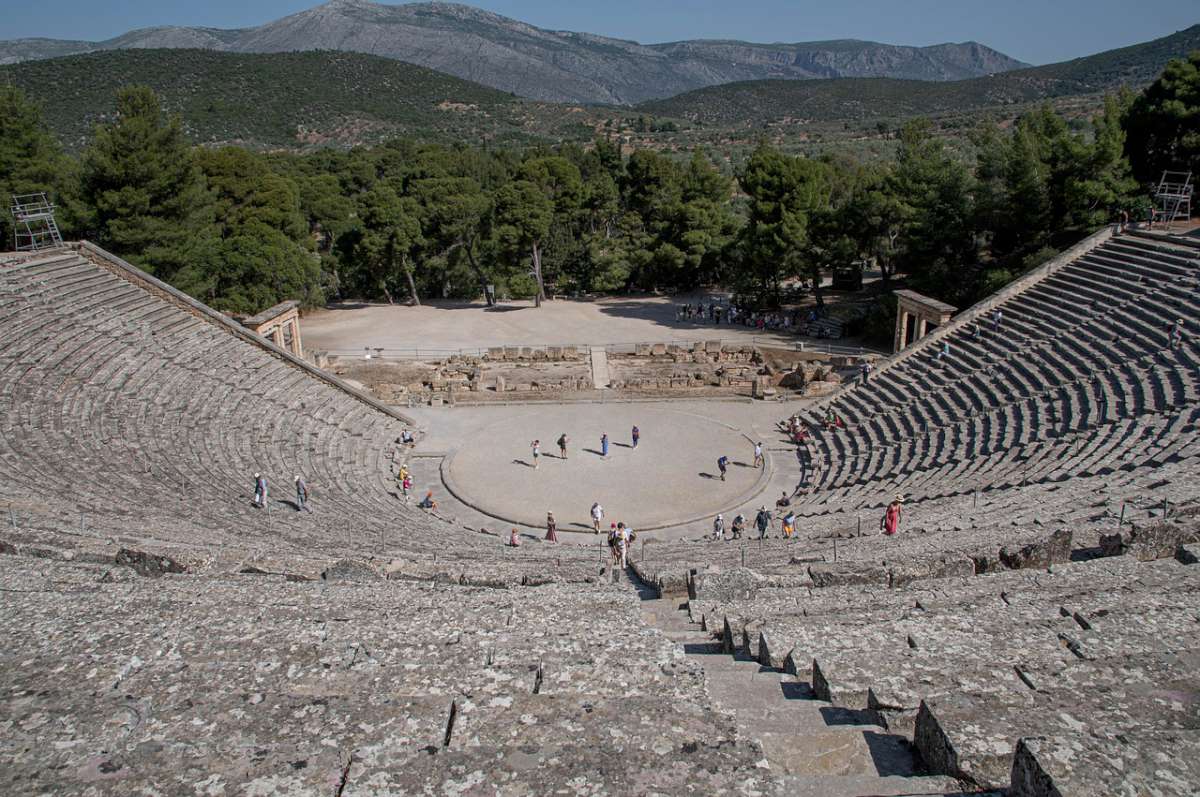
The theatre of Epidaurus — designed by the architect Polykleitos the Younger in the late 4th century BC, circa 340–300 BC — is unanimously considered the most perfect ancient Greek theatre in existence, its architectural achievement resting on three inseparable qualities: its proportions, its beauty, and its acoustics. The proportions of the theatre are of a mathematical precision and a visual rightness that impresses even those with no knowledge of ancient architecture: 55 rows of seats arranged in a slightly ellipsoidal curve following the natural contours of the hill, divided into an upper and lower section by a diazoma corridor, the lower section of 34 rows dating from the original 4th century BC construction and the upper 21 rows added in the 2nd century BC expansion. The perfectly circular orchestra at the centre — 19.5 metres in diameter, its smooth limestone surface intact — is the compositional heart of the whole, and the geometric relationship between the orchestra, the cavea above, and the stage structure beyond achieves a spatial clarity and a visual completeness that make standing in the theatre at any point — on the orchestra, at the top of the cavea, in the side passages — feel like occupying a position in a perfectly resolved work of three-dimensional geometry.
The acoustics of the theatre are the most celebrated and most scientifically extraordinary aspect of its achievement. Sitting in the highest row of the cavea, 55 metres from the orchestra, visitors can hear a coin dropped, a whisper spoken, or a match struck on the orchestra floor with perfect clarity — without any amplification, without any electronic assistance, and despite the distance and the open air. Scientific research has established that this extraordinary acoustic performance results from the specific geometry and dimensions of the theatre — the limestone seats acting as an acoustic filter that passes sound from the stage while suppressing ambient background noise — and from the particular shape of the cavea, whose slightly ellipsoidal form creates a pattern of sound reflection of optimal efficiency. Whether achieved by conscious acoustic calculation or by the inspired intuition of the architect Polykleitos the Younger, the acoustic quality of the Epidaurus theatre represents an achievement of ancient Greek architectural engineering that modern acoustic science, with all its computational resources, regards with genuine, unreserved admiration.
The Sanctuary of Asclepius
Beyond and around the theatre, the great Sanctuary of Asclepius — the reason for the theatre’s existence and the most complete ancient healing sanctuary surviving in the world — extends across the valley floor and the surrounding slopes in a complex of remarkable comprehensiveness and remarkable historical depth. The Temple of Asclepius, built in the early 4th century BC, was the religious heart of the sanctuary — the place where the gold and ivory cult statue of the god stood, and where the most sacred rituals of healing were performed. The Tholos — a circular building of the 4th century BC designed by Polykleitos the Younger, the same architect as the theatre — is the most architecturally refined and most theoretically challenging of the sanctuary’s buildings, its elaborate concentric plan of underground corridors and its three orders of columns (Doric external, Corinthian internal) making it one of the most discussed and most studied buildings in the history of ancient Greek architecture. The Enkoimeterion — the great dormitory where the sick slept in the hope of receiving the healing dream visitation of Asclepius — is the building most directly associated with the sanctuary’s therapeutic function: a long Doric stoa of the 4th century BC, its interior divided into sleeping chambers, where the ancient practice of divine dream healing was performed in conditions of ritual preparation and religious expectation whose psychological dimension is increasingly appreciated by modern medical historians. The Propylaia gateway, the stadium, the gymnasium, the baths, and the ancient hospital facilities complete a sanctuary complex of extraordinary completeness — a medical and religious establishment whose physical organisation reflects an understanding of the relationship between mind, body, spirit, and environment that anticipates, by two and a half millennia, the most sophisticated contemporary approaches to integrated healthcare.
The Archaeological Museum of Epidaurus
Adjacent to the sanctuary, the Archaeological Museum of Epidaurus houses the finest collection of finds from the Epidaurus excavations — sculptures, architectural fragments, medical instruments, and the extraordinary series of stelae inscribed with the accounts of miraculous cures attributed to Asclepius, whose vivid, specific, and often startlingly detailed narratives of healing give the most direct and most completely human access to the experience of the ancient pilgrims who came here in hope and left, according to the inscriptions, restored. The sculptural collection includes fragments of the pediment sculptures of the Temple of Asclepius and the Tholos of outstanding quality, and architectural members of sufficient completeness to give a vivid sense of the original appearance of these buildings in their prime. The museum’s most moving objects are the simplest: the votive offerings left by grateful patients who believed they had been healed by the god — terracotta models of the limbs, organs, and body parts that had been cured, deposited at the sanctuary in the thousands over centuries of continuous pilgrimage, and preserved in a collection that is simultaneously an archive of ancient medical belief and a testament to the oldest and most universal of all human impulses: the desire to say thank you for the gift of health.
The Epidaurus Festival
Every summer since 1955, the ancient theatre of Epidaurus has hosted the Athens and Epidaurus Festival — a programme of ancient Greek drama performed in the theatre by Greek and international companies that is one of the most important and most completely extraordinary theatrical events in the world. The experience of attending a performance of ancient tragedy or comedy at Epidaurus — sitting in the same stone seats that an Athenian citizen occupied in the 4th century BC, watching the same plays of Sophocles and Euripides and Aristophanes in the same theatre under the same Argolid night sky, the actors’ voices carrying to the last row with the same acoustic clarity that made the theatre famous in antiquity — is one of the most completely overwhelming and most completely irreplaceable cultural experiences available anywhere in Greece. The Friday and Saturday performances of the Epidaurus Festival attract audiences from across Greece and from every corner of the world, and the experience of driving through the pine forest to the site at sunset, joining the crowd of thousands assembling on the ancient stone steps as the light fades, and watching the plays of the ancient world performed in the most perfect theatrical space ever built is one that, once experienced, becomes a permanent and defining part of one’s understanding of what ancient Greek culture was and what it still means.
The Little Theatre of Ancient Epidaurus
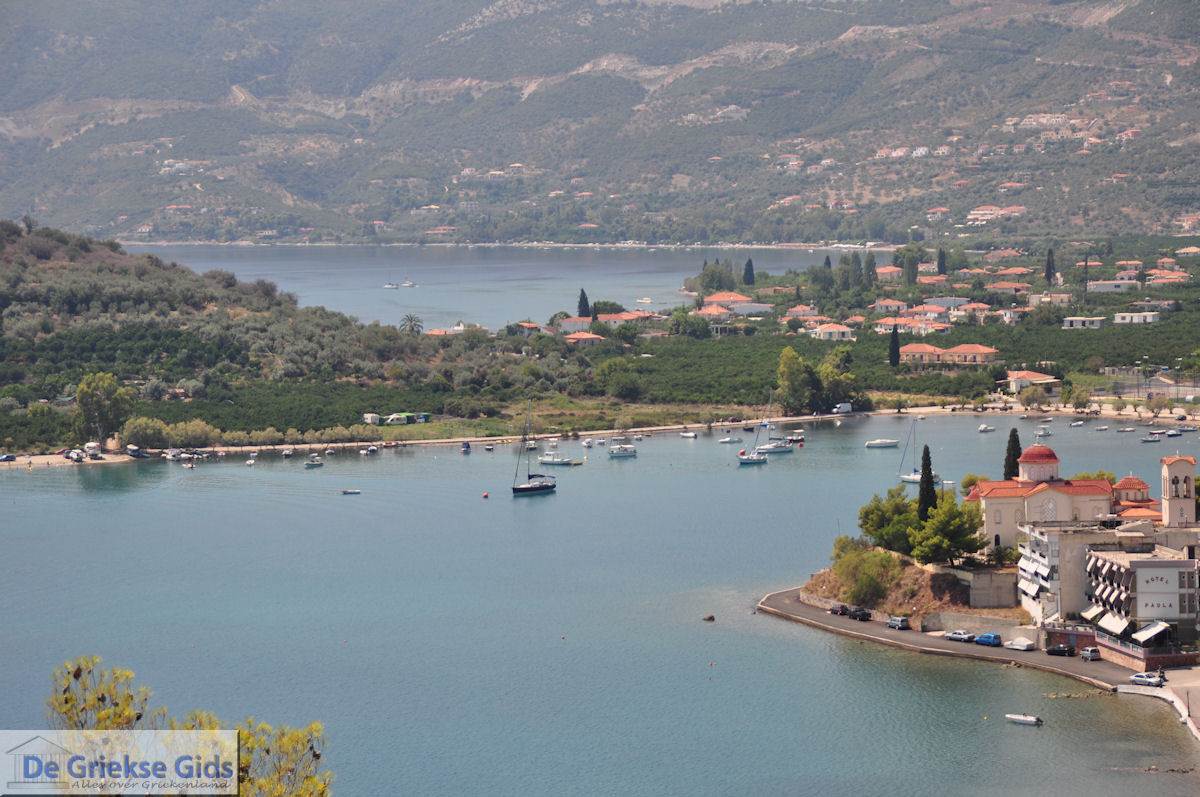
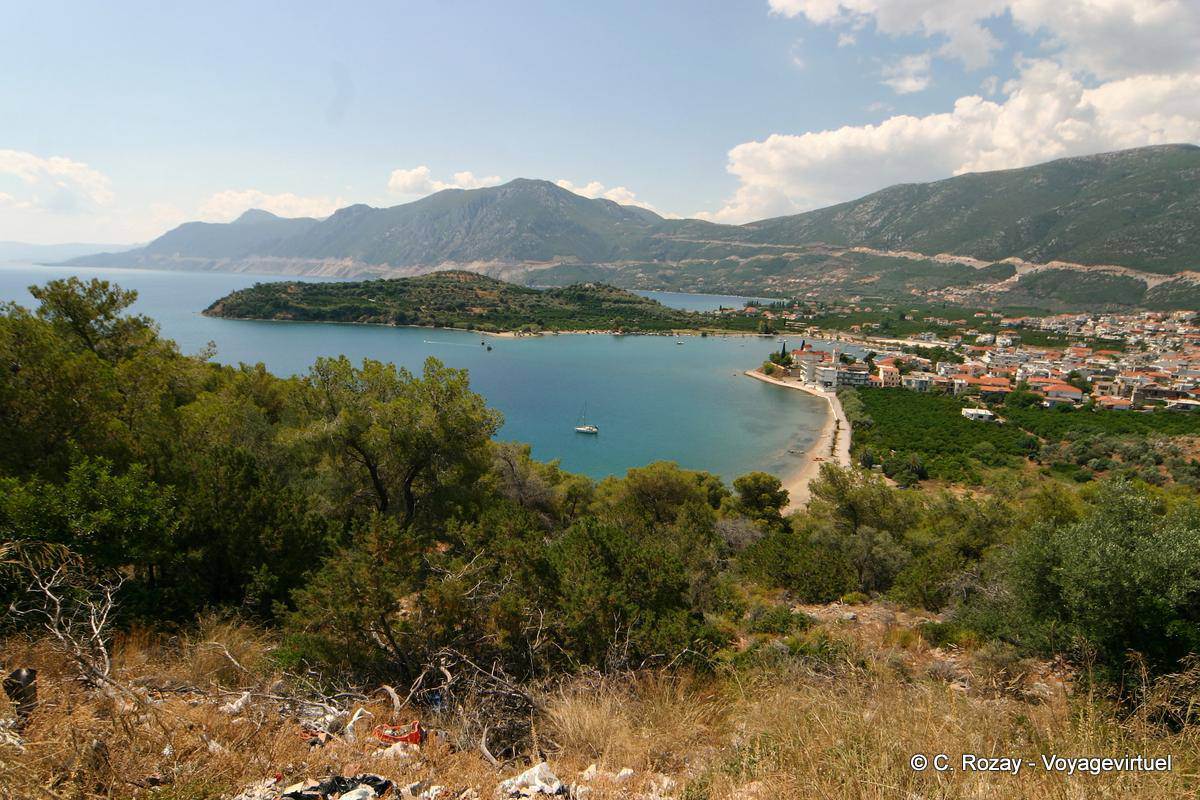
In the port town of Palea Epidavros, eight kilometres from the main sanctuary site, the Little Theatre of Ancient Epidaurus is a smaller ancient theatre of the 4th century BC — more intimate in scale than the great theatre of the sanctuary, its 3,000-seat cavea cut into a hillside above the sea with views of the Saronic Gulf extending to the horizon. The Little Theatre hosts its own programme of performances as part of the Epidaurus Festival, its smaller scale and its coastal setting offering a different and in some ways even more intimate quality of ancient theatrical experience. The town of Palea Epidavros below — a pleasant harbour settlement with good tavernas and a small beach — makes an excellent base for those who want to combine a visit to the sanctuary with a night in the Argolid and a morning swim in the Saronic Gulf before the drive back to Athens or the ferry to Aigina.
Why Choose Epidaurus
Epidaurus is the destination for every traveller who wants to encounter the ancient Greek world at its most completely and most overwhelmingly itself — who wants the experience of standing in the orchestra of the finest ancient theatre in existence and understanding, in a moment of immediate and entirely unmediated physical perception, why the ancient Greeks built as they did and what they were trying to achieve. It is for those who want to sit in the highest row of the Epidaurus cavea and hear a whisper from the stage below as clearly as a word spoken in the same room, and understand for the first time what “perfection” means as an architectural quality rather than a critical judgement. It is for those who come on a summer Friday or Saturday to attend the Epidaurus Festival and experience ancient Greek drama in the space for which it was written and in the acoustic conditions under which it was first performed — an experience that no modern theatre, however brilliant its design and however generous its budget, can replicate or approximate.
For those making the passage through the Saronic Gulf by yacht, Epidaurus is a natural and entirely compelling shore excursion — two hours by road from Athens, half an hour from Nafplio, and a short drive from the anchorages of the Saronic coast. The combination of an afternoon at the sanctuary with a night at anchor in the bay of Palea Epidavros and a morning sail south toward Hydra or Spetses creates an itinerary of extraordinary cultural and natural completeness — the finest ancient monument in the Peloponnese, the most beautiful neoclassical town in Greece at Nafplio, and the open waters of the Argolic Gulf ahead.
What Epidaurus ultimately offers — to the visitor who arrives with the full attention it deserves, who walks the entire sanctuary in the morning before the crowds arrive and sits alone in the theatre in the stillness of the early afternoon and hears the silence of the Argolid hills surrounding the most perfect acoustic space in the ancient world — is the experience that all travel to the ancient Greek world ultimately seeks and rarely so completely finds: the experience of being, without mediation or reconstruction or interpretation, in the direct and immediate presence of the greatest civilisation in the history of the western world at the precise moment of its highest achievement. That experience is available at Epidaurus with a completeness and a directness and a physical immediacy available at very few ancient sites anywhere in Greece, and it justifies, on its own, a journey of any reasonable distance to receive it.