Why Aigina
There are islands whose proximity to a great city might seem, at first consideration, to diminish them — to reduce them to the status of a weekend escape rather than a genuine destination, to make them feel like an extension of the urban world they are departing rather than an arrival in something genuinely different and genuinely worth the journey. Aigina refuses this reduction entirely. Lying barely 27 kilometres from Piraeus in the heart of the Saronic Gulf — the closest island of any real substance to the greatest city of Greece, reachable by high-speed ferry in 35 minutes and by conventional ferry in a little over an hour — Aigina is an island of such historical depth, such architectural beauty, and such completely genuine individual character that the accident of its proximity to Athens has shaped it into something more, not less, interesting than its remoter neighbours: an island that has been absorbing the energy, the culture, and the ambitions of the Greek world for five thousand years and that carries the accumulated weight of all of it — ancient maritime empire, classical temple, Byzantine ghost town, first capital of the modern Greek state, pistachio groves and neoclassical mansions — in a landscape of modest scale and extraordinary historical density that rewards exploration with a generosity entirely disproportionate to its 87 square kilometres.
The mythology of Aigina is as generous as its history. According to ancient tradition, the island takes its name from Aigina, daughter of the river god Asopus, whom Zeus abducted and brought to the island to father on her the hero Aeacus — who became the island’s first king, father of Peleus and grandfather of Achilles, and one of the three judges of the dead in the underworld alongside Minos and Rhadamanthus. This divine genealogy — connecting the island directly to the greatest of the Homeric heroes — gave Aigina a mythological prestige that reinforced its already considerable political and commercial significance in the archaic and classical periods. In the 7th and 6th centuries BC, Aigina was the dominant maritime power in the Aegean — a seafaring city-state of the first rank, trading with Egypt, Anatolia, the Black Sea, and the cities of the western Mediterranean, minting the silver coins that became the most widely accepted currency in the Dorian Greek world, and developing, between 656 and 650 BC, the oldest known system of weights and measures in the classical world. Its rivalry with Athens — the two great maritime powers of the archaic Greek world facing each other across the narrow Saronic Gulf — is one of the central dramas of early Greek history, resolved finally in 456 BC when Athens expelled the entire Aiginetan population from the island and settled it with Athenian colonists. The island never fully recovered its ancient eminence. But it never lost its identity, and the accumulation of its history — ancient, Byzantine, Venetian, Ottoman, modern — gives it a depth and a variety of historical experience available on very few islands of comparable size in the Greek world.
For a brief and historically decisive period, Aigina was the capital of modern Greece. When Ioannis Kapodistrias, the first Governor of the newly independent Greek state, arrived in Greece in January 1828 to establish the institutions of the new nation, it was to Aigina that he came — the island serving as the seat of the Greek government from 1828 to 1829, housing the first offices of the new state in the neoclassical buildings that Kapodistrias had constructed along the harbour front, issuing the first modern Greek currency — the phoenix — from the island’s mint, and operating the first printing press of the new nation. That brief, intense period of political primacy left indelible marks on the island’s architecture and on its identity — the neoclassical mansions of the harbour front, the Markellos Tower, the historical associations of every significant building in the town — that give Aigina a civic dignity and a historical seriousness entirely its own among the Saronic islands.
What to Do and What to See
Aigina is an island of great historical variety — ancient temples and Byzantine ghost towns, neoclassical harbours and medieval ghost towns, pistachio groves and excellent beaches — that repays a full day of unhurried exploration with a completeness and a depth of experience rarely available on a single Saronic island.
The Temple of Aphaia
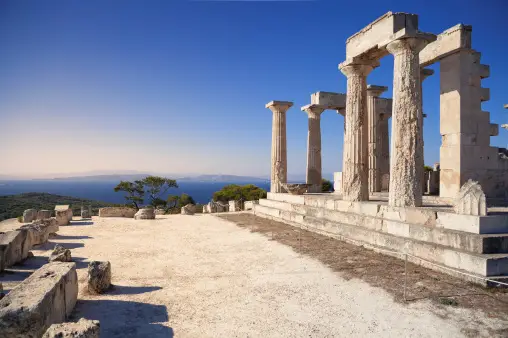
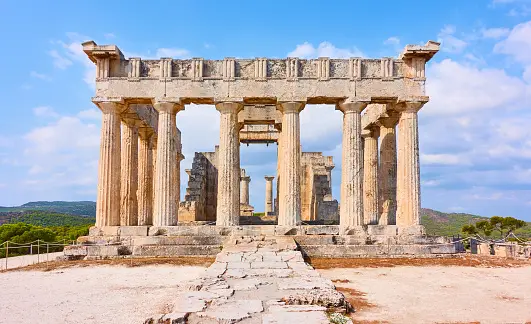
In the northeastern hills of Aigina, on a pine-forested ridge above the coast with views that extend on a clear day to the Acropolis of Athens on one horizon and the Temple of Poseidon at Cape Sounion on another, the Temple of Aphaia is one of the best-preserved and most completely beautiful ancient Greek temples in existence — a Doric temple of the early 5th century BC, built approximately between 500 and 480 BC and preserving 25 of its original 32 columns standing to their full height with substantial sections of the entablature above. Aphaia was a local goddess unique to Aigina — a minor deity of mysterious origins whose cult on this ridge was ancient and deeply rooted in the island’s identity — and the temple built to honour her is of the first rank of ancient Greek religious architecture: its proportions impeccable, its construction of the finest local limestone, its original pediment sculptures — now distributed between the Glyptothek in Munich and the National Archaeological Museum in Athens — among the masterpieces of the transition from Archaic to Early Classical Greek sculpture. The temple forms, with the Parthenon on the Acropolis and the Temple of Poseidon at Sounion, the three points of what ancient scholars called the “perfect equilateral triangle of temples” — a geographical and architectural alignment of three of the finest Doric temples in Greece visible simultaneously from the sea. The site is magnificent in itself; with the knowledge of this alignment and the views of the Attic coast below, it is one of the most completely moving ancient sites in the entire Saronic world.
The Temple of Apollo and the Kolona Site
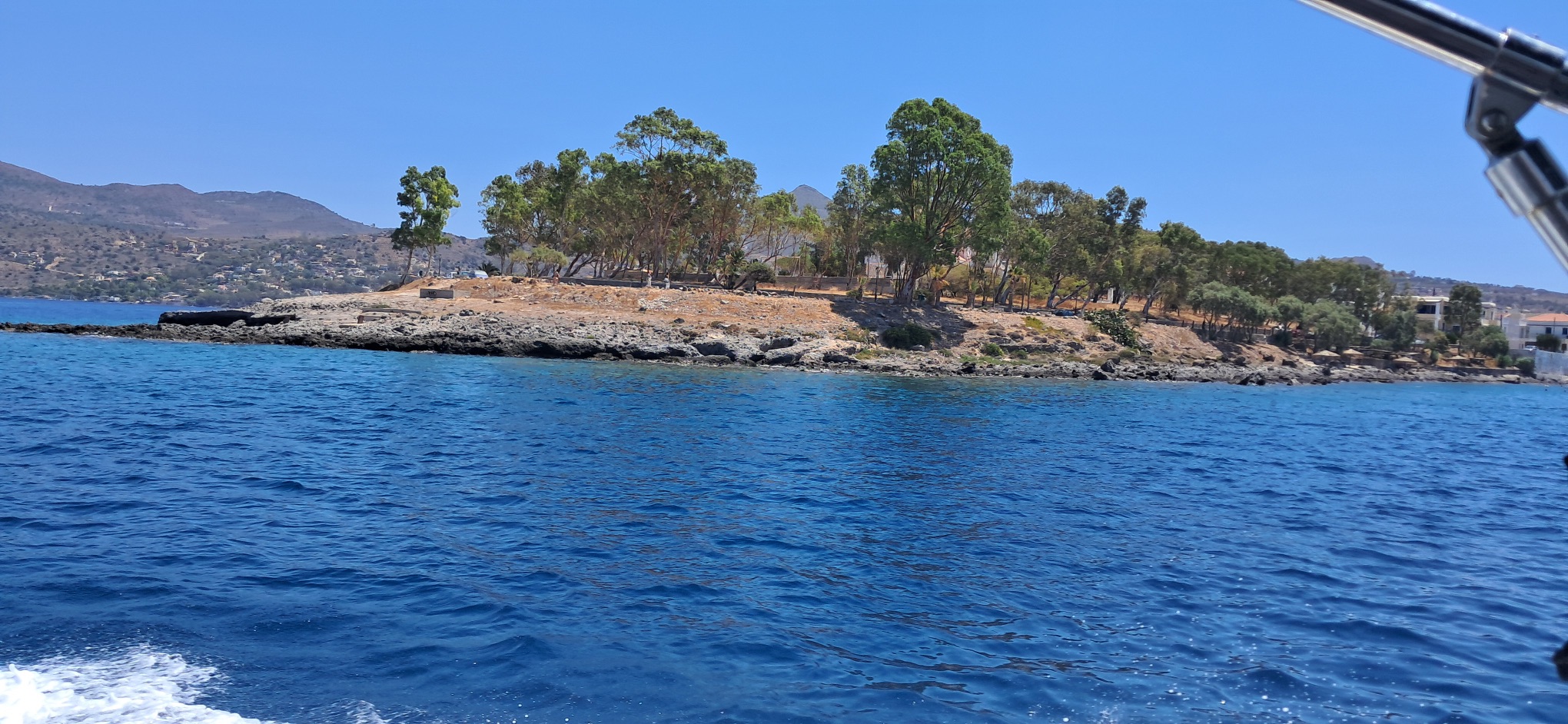
In the port town of Aigina itself, the archaeological site of Kolona occupies the headland at the northern end of the harbour — a site of continuous human habitation from the Early Bronze Age, around 3500 BC, through the late antique period, preserving the accumulated remains of twelve successive prehistoric, archaic, and classical settlements in a stratigraphic record of extraordinary depth and complexity. The single surviving column of the Temple of Apollo — the Kolona, or “column,” that gives the site its name, standing isolated on the headland above the sea in one of the most iconic silhouettes in the Saronic Gulf — is the last surviving element of a major Doric temple of the late 6th century BC, its solitary verticality against the sky and sea having made it the symbol of Aigina for centuries. The site museum, immediately adjacent, contains the finest and most comprehensive collection of prehistoric and archaic Aiginetan archaeological material available anywhere, with finds from the Bronze Age settlements of Kolona of exceptional quality and exceptional historical significance.
Palaiochora — The Byzantine Ghost Town
In the interior of Aigina, on a rocky hilltop above the modern road between the port and the Temple of Aphaia, the medieval ghost town of Palaiochora is one of the most extraordinary and most completely evocative historical sites in the Saronic islands — a Byzantine and post-Byzantine town of over 20 surviving churches and chapels, its houses long abandoned and reduced to their stone foundations, its ecclesiastical buildings preserving frescoes of considerable quality in states of romantic ruin, and its hilltop position offering views of the entire northern half of the island in all directions. Palaiochora was the island’s capital from the 9th century AD — when the coastal towns were abandoned to protect the population from Arab and later pirate raids — until 1826, when it was destroyed during the Greek War of Independence and the inhabitants descended to rebuild on the coast. Walking through its abandoned streets — the ruined houses, the frescoed chapels, the extraordinary silence of a medieval town that was lived in for nine centuries and then simply left — is one of the most atmospheric and most deeply felt historical experiences available on any island in the Saronic Gulf.
Aigina Town — The Neoclassical Harbour
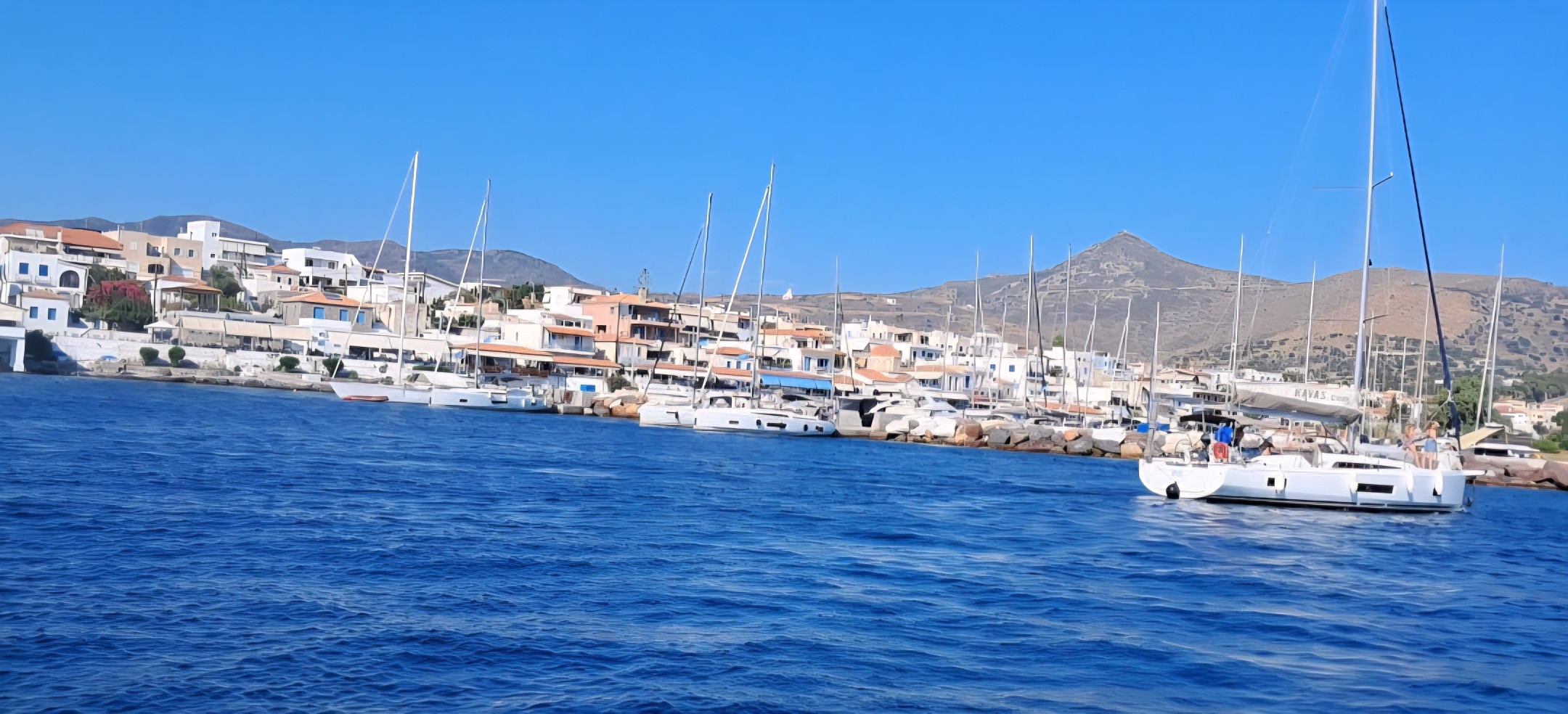
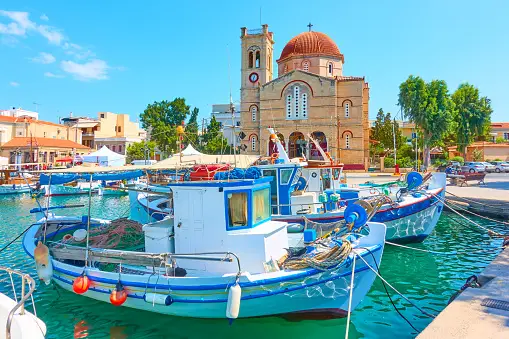
The port town of Aigina is one of the finest neoclassical harbour towns in Greece — its wide waterfront lined with dignified 19th-century buildings of considerable architectural quality, the legacy of its brief period as the capital of the new Greek state and of the prosperity that followed from its commercial activity in the 19th century. The Markellos Tower — a Venetian-era stone tower of great antiquity and great romantic presence, its pinkish lower walls and rounded turret rising above the harbour front — served as the first government building of the Greek state under Kapodistrias, and is one of the most historically charged and most architecturally distinctive structures in the Saronic islands. The fish market at the southern end of the harbour — where the day’s catch is displayed and sold in the traditional manner from the early morning hours — and the excellent fish tavernas and seafood restaurants of the harbour front make Aigina town one of the finest ports for an extended lunch in the Saronic Gulf, its combination of historical architecture, active working harbour, and excellent fresh seafood creating a dining environment of great variety and great pleasure.
The Pistachio Groves and the Aigina Fistiki
Aigina produces the finest pistachios in Greece — the Aigina fistiki, a Protected Designation of Origin product of international reputation, its nuts smaller and more intensely flavoured than most commercial pistachios and grown in the island’s volcanic soil under conditions of climate and cultivation that have been refined over generations of careful agricultural practice. The pistachio groves that cover much of the island’s interior — their low, spreading trees creating a characteristic landscape of gnarled branches and silver-green foliage that is entirely characteristic of Aigina — are productive from July to September, and the harvest festival of the Aigina Fistiki Fest, held each September in the port, is one of the most genuinely local and most genuinely pleasurable island festivals in the Saronic Gulf. The island’s shops and market stalls offer Aigina pistachios in every imaginable form — roasted, salted, in pastries and confections of traditional Greek craftsmanship — and buying a bag of Aigina fistiki at the harbour front market and eating them on the ferry back to Piraeus is one of the most characteristic and most completely satisfying of all Saronic Gulf rituals.
The Beaches
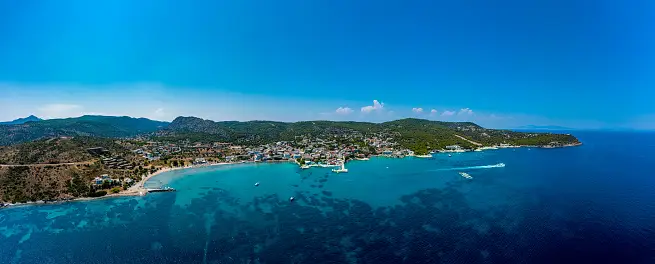
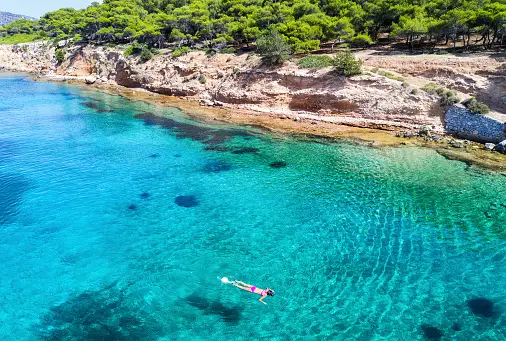
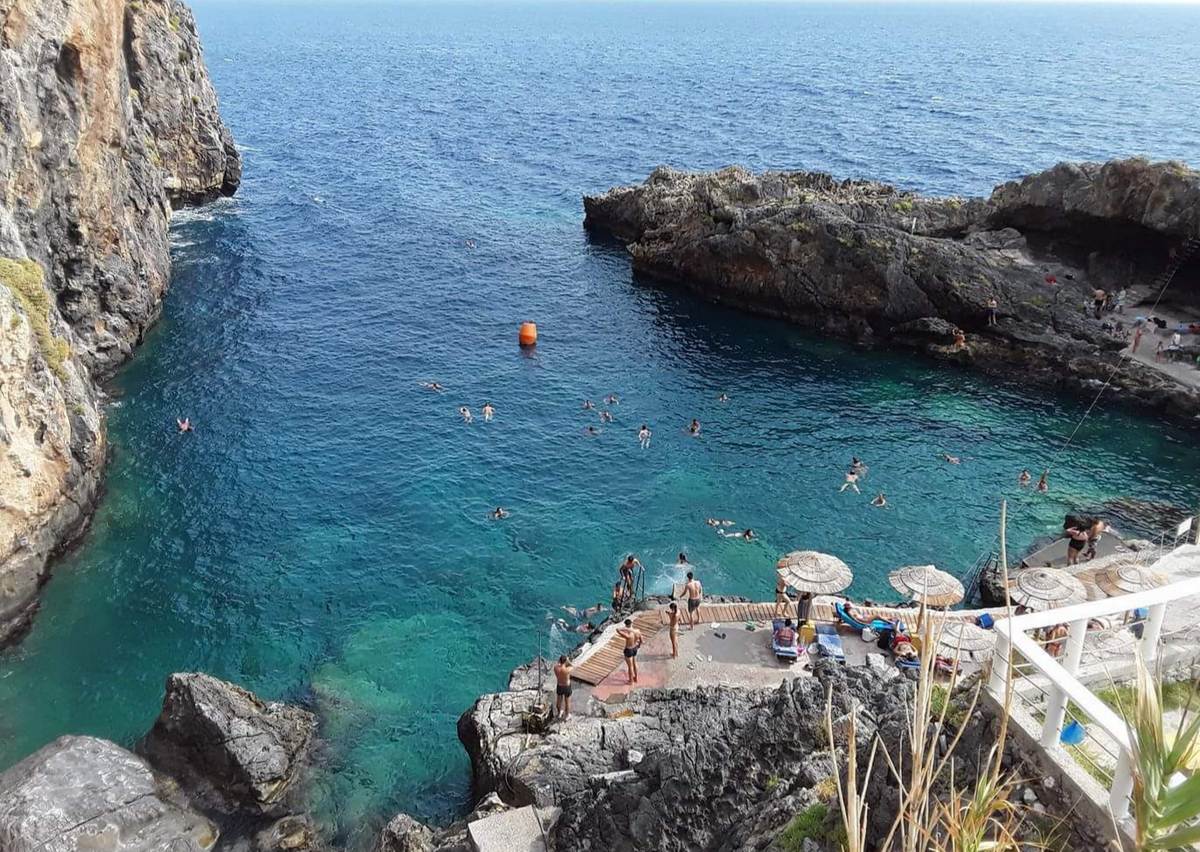
Aigina has a coastline of 57 kilometres enclosing beaches of considerable variety distributed around its three coasts. Agia Marina, on the northeastern coast below the Temple of Aphaia, is the island’s principal beach resort — a long, sandy beach of good natural quality with the full range of facilities and the animated summer atmosphere of a well-established Attic beach destination, its Blue Flag award reflecting the quality of its water. Aeginitissa, on the western coast, is quieter and more sheltered. The beaches of the southwestern coast around Perdika — a charming fishing village of genuine character and excellent fish restaurants — are smaller, calmer, and more intimately Saronic in atmosphere. And the small island of Moni, visible from Perdika and accessible by small boat in a ten-minute crossing, has beaches of great natural quality in a completely undeveloped setting, its protected waters and dense pine forest making it one of the most completely natural swimming destinations in the Saronic Gulf.
Why Choose Aigina
Aigina is the island for those who want the complete historical experience of the Saronic Gulf — the finest ancient temple in the group at Aphaia, the most atmospheric Byzantine ghost town in the islands at Palaiochora, the most historically charged neoclassical harbour in the Saronic at the port town, and the most famous and most completely distinctive agricultural product of the archipelago in the Aigina pistachio — in an island of genuinely accessible scale and genuinely comfortable pace that repays a day’s visit or a longer stay with a completeness and a variety of experience available on no comparable island in the Gulf. It is for families who want to combine an excellent beach at Agia Marina with a visit to one of the finest ancient temples in Greece. It is for history enthusiasts who want the full range of Aigina’s extraordinary historical record — Bronze Age to Byzantine, ancient to neoclassical — in a single day of unhurried exploration. It is for food lovers who want the finest fish lunch in the Saronic Gulf at a harbour-front table in Perdika, followed by a bag of Aigina pistachios as the finest of all possible island souvenirs.
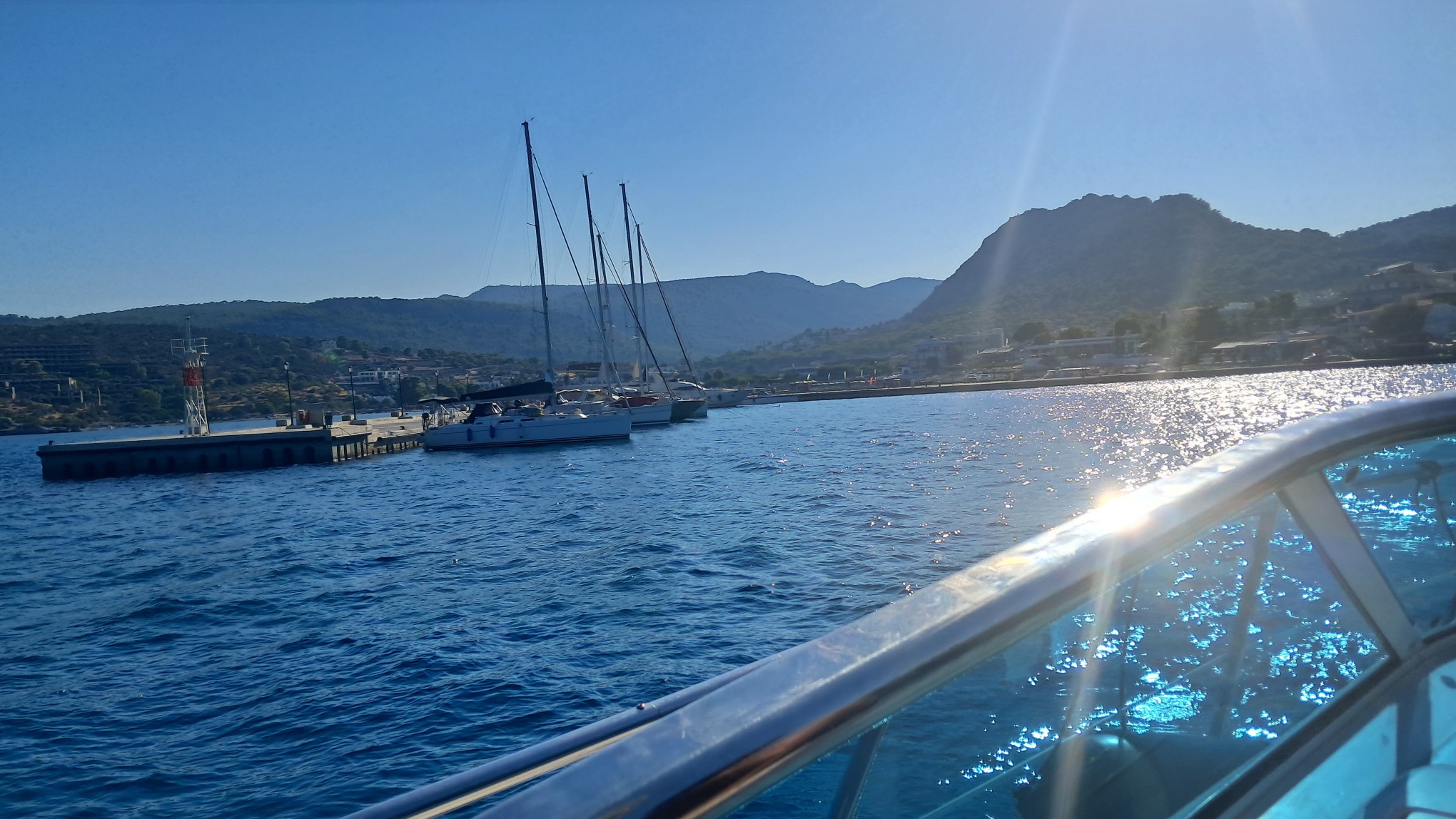
For sailing itineraries in the Saronic Gulf, Aigina occupies the central and most strategically significant position in the group — equidistant from the Attic coast, from Poros and Hydra to the south, and from the open waters of the Saronic to the east, its great natural harbour one of the finest and most completely sheltered anchorages in the gulf and its combination of historical monuments, excellent restaurants, and reliable facilities making it the natural hub of any Saronic sailing programme. The passage from Aigina south to Poros through the narrow channel between the island and the Methana peninsula is one of the most beautiful short passages in the Saronic — the pine-covered Methana coast to port, the terraced hills of Aigina to starboard, and the open gulf ahead narrowing into the dramatic entrance of the Poros channel.
What Aigina ultimately gives the visitor who comes to it with the full attention it deserves — who climbs the pine-forested hill to the Temple of Aphaia and stands among the columns with the views of Athens and Sounion on either horizon, who walks the abandoned streets of Palaiochora and reads the frescoes of its ruined chapels in the afternoon silence, who eats grilled fish at a table in Perdika with the open Saronic stretching away to the south and a bag of freshly roasted pistachios on the table beside the wine — is the experience of an island that has been, at various moments in its long history, the most powerful maritime city in the Aegean, the seat of the first modern Greek government, and the most beloved weekend island of the greatest city of Greece, and that carries all of those identities simultaneously with the easy, unhurried authority of a place entirely at peace with everything it has been and everything it is.